Pages

Labels

Showing posts with label stock options. Show all posts

Tuesday, October 18, 2011

Stock Options Trading: The Long Strangle Doesn't Lie

Another exotic sounding name for a financial instrument about nothing guaranteed. These types of financial tools challenge the mind to think in dynamic ways, but are more like working for a fee than investing. In other words, to implement the long-strangle stock option, traders are charged a fee to purchase two stock options making it more like paying to play with a sophisticated financial toy. It might make one look like they're clever, but if the money is not flowing, who cares about that. Bottom line is if it costs money, and does not guarantee payment, there is room for either party to win or lose. Moreover, a strong market sense can help leverage the power of stock options, but recognizing if one has that sense or not is a good idea. 

To clarify further, the long-strangle is a trading method and not an investment strategy. The technique involves the purchase of a long-call and long-put per the Options Industry Council (OIC). Don't be fooled by the elaborate language, it's financial jargon for the option to purchase at a discount while simultaneously having the option to sell at a little less of a discount. Figuratively speaking, it's not really comparing pears to grapes to say if someone buys 10 apples on discount but sells 9, their net worth will rise if apples increase in value and a lower  pre-arranged price was negotiated. So why not just buy 10 apples? Better yet, why not grow them?

The long-strangle insures the purchase of stock shares on discount through the long-put which is the instrument that sells on discount. In other words, the call option gives the purchaser the right to buy shares at a price lower than the future market price if the price rises and the put option gives the purchaser the right to sell shares at a higher price than a future market price if shares decline in value. In both cases the options might cost a little less than actually buying the shares directly if the contract fee doesn't offset that discount. If only the call option had been purchased there is no downside protection. In this sense, the put option is like a partial refund if the apples go bad before eating or selling them. Sounds complicated doesn't it. If it is too confusing to invest without knowing exactly what is going on, consider that a red flag.

Why is it called a long-strangle? TD Ameritrade's “Think or Swim” says it's because the stock option  strangle takes advantage of both sides of the position i.e. up or down price movements. So it is like strangling the price from both sides but applying a little less pressure on the upside because you think that's the direction it's going to go. It's also an intellectual stranglehold on common sense for the 13 reasons described by Ex-Options trader Stephen Whitney who came clean on his losses. Learn from Mr. Whitney's mistakes, you don't necessarily need to think very hard to swim, you just have to know how. In other words, if making money is more about understanding how to do it instead of knowing when more is better than less, then stock options trading tactics such as the long-strangle might not necessarily be such a good technique to be using.

Monday, October 17, 2011

Options Trading: Collar Strategy Overview

The 'collar' is one of several types of stock options techniques, and is a relatively conservative way to insure investment  gains in corporate shares, and in some cases, a way to multiply dividend profit. The option involves three simultaneous transactions per the Options Industry Council. This  stock option strategy in effect locks in capital gains, for a time, without having to sell shares.  For example, if a shareholder has experienced an increase of .20 cents per share on 100 shares and believes the price of Coca-Cola shares could fall, writing a 'call option' against those 100 shares  pays for the premium of buying the protective put option which increases in value when the share price falls.

In order to fully grasp this stock option strategy it is necessary to understand the component parts of the collar strategy i.e. the long-put and call option. A put option is a bet that increases in value as share prices fall. These transactions can either be 'written' or 'bought'. The writer of a put option buys shares on margin or owns underlying shares, then charges a fee or premium to the buyer. Each stock option is 100 shares and gives the buyer of the option to sell shares at a pre-determined price. If the price per share falls, the buyer of the put option can sell for a profit at the expense of the option writer.

A call option is the inverse of a put option and allows the option holder to buy shares at pre-determined amount. For example, Mr. A buys 10 call options to buy ABC Corporation at $1.00 per share for a cost of .10 cents per share. This means the premium will be 1000 x .10 cents= $100. In order to make a profit above unrealized gains for a call option alone, the price per share must increase more than .10 cents per share. When purchased, a call option is a form of leveraging to higher level than might be possible than buying on margin. However in a collar, the call is leveraged by the underlying shares owned by the seller and the premium is used to purchase the put.

The Options Industry Council states collar options are good for protecting 'unrealized gains'. In other words, if the share price falls, the collar option covers the cost of that fall while allowing the shareholder to continue holding the underlying shares. It's a slightly bullish strategy and can also be used to claim dividends without risk according to  Michael Thomsett of Minyanville. In both cases the strike price of the options and the cost of the collar premiums is going to be an important factor in determining whether or not the options is a profitable technique to use.

To be profitable and work, the premium from writing the call option should be close to the premium for buying the put option. Additionally, the strike price for both options should be equidistant from the out-of-the-money price which should be the same for both options. For example, if Mr. A writes a call option for ABC Corporation and purchases a 'long-put' option, the out of the money price is ideally $1.00 per share for both option contracts. Moreover, the option cost is also ideally the same; for example, .10 cents per share.

Friday, March 11, 2011

How Elimination of the Up-Tick Rule Profits Short Sellers and Increases Volatility

An up-tick is simply an upward movement in the price of a financial security such as stock price. This rule affects traders of financial securities such as stock options. In the summer of 2007 an interesting event occurred in the regulation of securities exchanges, specifically the Securities and Exchange Commission (SEC) eliminated the requirement for what is called the up-tick rule. Since then, the combination of the financial crisis coupled with the elimination of the up-tick rule led to increased scrutiny of the rule despite the SEC's initial reasons for implementing the 2007 amendments to rule SHO.

The elimination of the up-tick rule profits short-sellers who are locking into sales prices they think will be higher than the actual future price. Since the up-tick rule required there to be an upward movement in price(s) before a short sale can be initiated, the rule made it more difficult for prices to move downward as fast as they could have the rule not existed. With the elimination of the up-tick rule, short sellers of financial securities have the added advantage of downward price movements in the event of a low buy to sell price ratio.

Illustration of the uptick rule

To illustrate the above with an example, if you know the price of 100 cattle is $2000.00/head and you want to profit off the price movements of those cattle, you may enter into a short-sale contract at the Chicago Mercantile Exchange (CME). The reason you might do this is because you think sales of beef are on the decline and that will cause downward price movement on the price of cattle. If no up-tick rule is in place and lots of other futures traders also think there will be a downward movement in the price of cattle, then there is one less obstacle in the way of declining cattle prices.

Elimination and reinstatement of the uptick rule

The up-tick rule was eliminated from securities regulation after the bursting of the housing prices bubble had begun and during the early phase of the credit-crisis. Financial observers of the up-tick rule removal postulated the move aggravated and exaggerated the decline in market prices that helped develop the credit crisis into something worse causing the ensuing financial crises. In other words, the timing of the up-tick rule elimination might explain why some IRA's or 401K's might have experienced shocking losses of value.

Had the up-tick rule been in place during the credit-crisis, the massive 1-day declines seen in the stock market might not have been so volatile and steep. In light of mounting evidence and pressure to reinstate the up-tick rule, both the SEC and some legislators within the U.S. House of Representatives reconsidered the idea of reinstating the up-tick rule in the January 2009 bill 302 of the 111th Congress, after the July House of Representatives Bill 6517 appealing to the same thing failed. Similar but not exactly the same calls for reinstatement of the up-tick rule were designed by NYSE-Euronext and other stock exchanges in 2009 as reported by Marketwatch.com in March of 2009. This in theory would add stability to the economy during periods of economic decline or slowed growth for the same reasons the up-tick rule was implemented after the great economic depression of the 1930's.

Summary

The elimination of the up-tick rule profits short sellers and increases volatility because it is essentially removing an obstacle to downward price pressure. If everyone can't sell at once, it leads to less steep declines and more even securities price movements because the prices have to go up before each short-sell can be initiated. In other words, for every step back, a step forward must be taken first necessitating the step back in price movement to be larger than the step forward. Moreover, if long positions in securities decide to sell off, the possibility of amplifying this sell off with short selling becomes more limited because of the up-tick rule. Hence, elimination of this rule can lead to both unrestrained dumping of long positions in addition to leveraged selling through short sales contracts.

Sources:

1.http://www.foxbusiness.com/story/markets/industries/finance/sec-reinstate-uptick-rule-calm-markets/
2.http://www.investopedia.com/terms/u/uptickrule.asp
3.http://www.investopedia.com/terms/s/shortsale.asp
4.http://seekingalpha.com/article/74825-no-uptick-rule-a-convenient-scapegoat
5.http://www.marketwatch.com
6.http://www.govtrack.us/congress/bill.xpd?bill=h111-302
7. http://tinyurl.com/66yetxk (SEC.gov)

Wednesday, March 9, 2011

Understanding Stock Options' Strike Price, Excercise and Expiration Date

Options are a loan contract given to an investor or investors so they may leverage their financial position to a greater level. An options contract allows the investor to purchase a large volume of securities on 'margin' at a proportionally lower but representative price with the knowledge that (s)he may have to pay back the financial institution if the option does not perform the way the investor intended. 

Unlike regular stock trading, options are traded with the intent and choice of either selling or buying the underlying securities within the options contract. In other words, the options trader has an option or choice regarding how money is intended to be made i.e either a rise or decline in the security. There is a fair amount of financial lingo associated with options trading but three of the more important and fundamental terms are strike price, expiration date and exercise.

Strike price

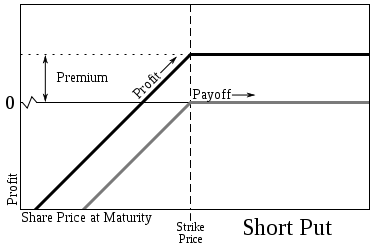
Options are traded as 'calls' or 'puts' a call option is purchased with the intent to purchase the stocks in the option. This future purchase price is called the strike price and is different from the option price. If the price of a stock goes up during the term of the option, the trader or investor may get a deal having locked into a lower strike price. An option strike price may also be a sell price in the case of a 'put'. 

Short put option
Source: 'Gxti'; CC By-S.A. 3.0

This is also called short selling as the trader is betting the stock will go down during the term of the option. For example, if a trader buys a put option of Pear Inc. with a strike price of $55.67 and the price of Pear Inc. drops during the term of the option, the trader can then sell the option at the strike price of $55.67 and make a profit if the option cost was lower than the strike price.

Expiration date

Options are purchased with time limits. Like a bottles of milk, options expire at a set date in the future. This time limit is often in increments of 30 days. For example, if an option is purchased at the beginning of the month, that option will likely expire at the end of that same month. However options can be bought with expirations several months into the future. 

The usual extent of options is four months but some options have what are called 'LEAPS' which allow options contracts to exist for more than four months. For example, if it is July now, a July option can be bought with an expiration of July 31 or an August option can be bought with an expiration in August. If LEAPS are available for the option, a contract for November should also be available.

Exercising an option

The terms of an option require the buyer to either exercise, continue or cover an option. When exercising a call option for example, the investor buys in at the predetermined strike price stated in the option. If the price of a stock has increased enough half way through the options term, it is a calculated decision by the investor to exercise the option before its expiration. If the price goes down, the trader can either wait and hope the price will go back up or cover his or her position by exercising at a loss. Naturally, this is not a favorable scenario for an options trader.

Options are a leveraged form of securities trading and make possible high volumes of exchange. Options can be traded for stock, commodities and currency markets. Options are bought ahead of time based on the traders anticipation of either an increase or decrease in the actual price of the security being traded and not the option price itself. 

Options contracts are separate from the underlying securities which they represent in the sense that the contract is a unique financial instrument in and of itself. In the case of stock options, a brokerage firm would offer a margin to the investor so they may utilize the options market. While there are quite a few intricacies and terms associated with options trading, three of the most important aspects of options are the strike price, expiration date and the exercising of the options contract.

Sources:
 
1. http://www.investopedia.com/terms/s/strikeprice.asp
2. http://en.wikipedia.org/wiki/Option_(finance)
3. http://www.investopedia.com/articles/optioninvestor/03/090303.asp
4. http://invest-faq.com/articles/deriv-option-basics.html
5. http://en.wikipedia.org/wiki/Exercise_(options)

Monday, March 7, 2011

Companies to Consider for Covered Call Investments With an Appreciating Dollar

In implementing covered call stock options, an investor or trader may do so with the belief the price of stock will remain flat or decline in value before a stock option's expiration date. Combining this principle with markets that are predicted to not outperform as a result of high gasoline prices may yield suitable covered call selections within those industries.

Choosing industries that rely heavily on gasoline is an obvious possibility for covered calls because this increases operation costs. Moreover, if those increased operation costs cannot easily be passed onto the consumer for stable or higher revenue growth, a considerable outcome could be lower profit margins, which can influence share prices.

Three industries that do make heavy use of gasoline in their daily services are 1) Land based logistics companies, 2) air based logistics and transportation companies and 3) Gas powered tanker businesses. Secondly, industries that's products or services require consumers to use large amounts of gasoline with those products may also be affected by high gasoline prices. Two such industries are 1) automotive manufacturers and 2) non-essential gasoline powered equipment suppliers.

• Expeditors International of Washington Inc. (EXPD): EXPD makes heavy use of logistics services. These services include both ocean and air transportation and consequently require large amounts of gasoline.

• JB Hunt transport services, Inc. (JBHT) JBHT exists within a competitive trucking industry making large price increases commensurable only insofar as the market and competition allows.

• Knight Transportation Ltd. (KNX) KNX is another US based over land transportation company. This business is also in competition with other refrigerated logistics providers.

• United Parcel Service, Inc (UPS) UPS is a well known freight and package delivery company that's fleet is one of the largest in the World.

• Southwest Airlines Co. (LUV): Despite fuel hedging and low operating costs, LUV is potentially vulnerable to high gasoline prices because unlike some premium airlines, its costs have already been reduced to a large extent allowing the rising cost of fuel to have a potentially more direct impact on revenue.

• Deere Co (DE): DE, also known as John Deere manufactures and sells large equipment to a number of industries including agriculture, commercial, construction and the leisure based service providers such as golf courses. The high cost of gasoline may cause some buyers of such equipment to repair existing equipment, and hold off purchasing new equipment.

• General Motors Corporation (GM): In addition to high competition from foreign automotive companies, GM faces a domestic market facing a large increase in private transportation costs. The combined affect of foreign competition and high gas costs may flatten or lower GM's share prices.

While no covered call is a sure bet, and gasoline prices may have already been priced into stock prices, demand for gasoline and supply of gasoline are not generally predicted to change for the better in the near future. Such being the case, the above companies and one's similar to it may follow a flat share price trend in the near future.

What Is The Options Industry Council

The Options Industry Council (OIC) is a not for profit organization that exists to assist the public in becoming informed about options through education, and options market information. For persons new to or experienced in options trading, the OIC may be useful in expanding awareness of options trading strategy and technique in addition to becoming more aware of options market news and exchanges. The OIC is sponsored by a number of options exchanges and builds awareness for the options industry in addition to educating the public on the dynamics of that industry.

Why the OIC is important

The OIC provides a comprehensive and free educational service not necessarily provided by brokerages and independent options strategy companies. These services include simulated options exchange through the OIC 'Virtual Trading System', seminars from options professionals, and free educational coursework through the OIC's 'MyPath' program. The OIC also provides a 'strategy screener' that compares and illustrates options positions and their relative risk and strengths.

The Options Industry Council is given credibility via its not for profit status, educational tools and information in addition to the sponsorship from several options exchanges such as the Chicago Board Options Exchange. These options exchanges themselves participate in the regulation of the options markets. This is done through the Options Regulatory Surveillance Authority (ORSA) which was sanctioned by the U.S. Securities and Exchange Commission in June of 2006 according to SEC Release NO. 34-53940 NO. 34-53940. The Commodity Futures Trading Commission (CFTC) is also instrumental in regulating options trading. The SEC does not directly endorse the OIC but was evidently instrumental in its creation and does provide a web link to the OIC via the SEC website.

How to benefit from the OIC

The Options Industry Council is a helpful site to visit for options traders and interested parties from many levels of experience. The course work, trading tools, market information and seminars can all prove helpful in building knowledge of the options market, becoming acquainted with options trading strategy, and learning how to trade options via simulation. By participating and learning through the OIC, investors and traders alike can learn new investment skills for free and gain know how that might cost hundreds if not thousands of dollars in formal education program making it a cost effective resource.

The Options Industry Council may not provide investors or traders with everything they need to know about trading options, but it can be helpful in learning the mechanisms of the market so they are not incorrectly used. Not knowing how to trade options yet alone how to trade in different types of market environments can be detrimental to profitable and safer options trading. Being informed about these things by the OIC potentially improves the probability of succeeding in options trading. The OIC tools and resources can build confidence, ability, awareness and skill among persons interested in options trading.

Summary

Knowing what the Options Industry Council is can benefit all persons involved or interested in options trading. The OIC is a highly regarded, thorough and educational organization that is important to the options industry and public alike. Both options traders and exchanges may benefit from the existence of the OIC as it reputably builds awareness and provides useful information about options. The site itself is functional, easy to navigate and helpful with step by step instructions, far reaching options and options market information, frequently asked questions and answers and much more. Some of the advanced features of the OIC include information on statistical indicators,

Sources:

1. http://www.optionseducation.org/ (Options Industry Council)
2. http://www.sec.gov (Securities and Exchange Commission)

Thursday, March 3, 2011

Perils Associated With Day Trading Stock Options

Day trading has between a 5-30% statistical chance of success according to market observers and financial analysts. The North American Securities Administrators Association (NASAA) has reported 70% of stock day traders lose all their capital through day trading. (1)

Risk alone is a major peril of day trading stock options. The reasons why day trading stock options is risky, especially to those unfamiliar with the practice, is lack of know how, the debt leveraging involved in day trading stock options, and the unpredictability of the market in general.

• Complexity of options rules

The actual process of day trading stock options is a peril because of the complexity and attention to detail that rapidly changes with fluctuations in market conditions. Moreover, risk management methods vary with the financial instrument, industrial sector, investment type etc., and a new technique may be needed for each trade depending on what is most financially suitable for the market. Properly learning how to day trade stock options can have positive results on the probability of success, but this isn't necessarily easy. However, those who are able to learn how to day trade mostly do not lose money as confirmed in a U.S. Securities and Exchange Commission (SEC) report that quotes the Electronic Traders Association (ETA).(2)

• High capital investment

According to the Financial Industry Regulatory Authority (FINRA), day traders who do so more than 4 times in one week with more than 6% of their trading capacity are subject to a minimum stock reserve of $25,000.(3) This is a large amount of liquid capital that can incur opportunity cost and risk of its own.  For example, if the $25,000 consists of the majority of the day traders net capital worth, and the aforementioned day trading risks apply, then that day trader is putting a large amount of their financial security at risk.

• Margin calls, commissions and fees

Another peril of day trading stock options are the costs of day trading. Since day trading involves frequent buying and selling, transaction commissions and fees can add up fast. If those transactions do not yield a profit in excess of the commissions and fees, not only has the option day trader lost money, but time as well.

Options contracts are usually based on cost per 100 shares not including broker commissions and generally cost more per contract when the perceived chance of success is higher. For example, an option to buy 10 option contracts to sell British Petroleum before January 2012 might cost  $38.80 per contract at a share price below $70.00 but only $3.50 at a share price below $17.50.(4)

• Increased stress

A fourth peril of day trading stock options is the stress. The U.S. Bureau of Labor Statistics (BLS) sites professions in Securities, Commodities and Financial Services Sales to be among the more stressful.(5) In the case of retail stock option day traders, this follows by extension as the amount of money that can be gained or lost in a matter of moments is large making the threat of bankruptcy, massive debt and great loss of financial stability real.

In summary, the perils of day trading stock options are considerable and worth paying attention to if sound financial planning, and a relatively stable life are of interest. The potential loss, stress, costs, time and risks involved in day trading stock options are significant perils that make it less of an easy money scenario, and more of a high stakes, time consuming and complex series of tasks that repeat themselves several times per week.

Sources:

1. http://bit.ly/cjZBLs (NASAA)
2. http://bit.ly/bHsmy5 (Securities and Exchange Commission)
3. http://bit.ly/9PzpRD (FINRA)
4. http://yhoo.it/cTv1Gp (Yahoo Finance)
5. http://bit.ly/9sFnOT (Bureau of Labor Statistics)

Tuesday, March 1, 2011

What is An Options Spread?

An options spread is a technique used in stock options trading that makes use of two financial instruments known as 'options' orders so as to hedge risk and increase probability of profit by making use of different price movements by writing, selling, and/or buying options. An options spread can be used with any underlying market that allows trading via options.

The name option spread is no coincidence as the option is literally an option to use a financial instrument for a price. A spread represents two price points such as in a bid/ask spread, only in options, the spread is between two prices. When the words 'option' and 'spread' are brought together, so are the meanings of each word i.e. two options that represent a trading technique that involves financial contracts.

How an option spread works

Options are a derivative financial instrument meaning their value is derived from an underlying product. For example, with stock options, shares of a company are packaged into groups of 100 and bought and sold for a contract price or premium. The options can be either in the money, at the money or out of the money. This means the price of the underlying financial instrument can be either profitable, not profitable or even when exercised or used.

This contract, if bought, allows buyer to 'exercise' the options at a certain price before a specific date. If sold, the buyer of the option pays a premium to the seller and the seller pays the buyer if the option is exercised 'in the money' or beyond the 'strike' price i.e. the price after which the option becomes profitable. Some of the key elements of an options spread are listed below:

• Order type: ex: Limit order, market order, stop loss
• Risk: Potential to lose money via the spread
• Market: ex. Bull, bear, secular, cyclical
• Strategy: Option spread(s) used
• Broker: Trade facilitator
• Product: Stocks, commodities, currency


Types of option spreads

The type of option spread used reflects the strategy of the spread. For example, a calendar spread makes use of two different expiration dates for the same type of option. This type of spread may be used when the buyer or seller is convinced of a price movement but not the time when the price movement will occur. A number of different spread types exist, some of which are listed below:

• Bull Call Spread: Hedges cost of bullish options
• Bull Put Spread: Premium benefit if stock remains above strike price
• Bear Call Spread: Benefits flat price movement
• Bear Put Spread: Inverse of Bull Call Spread
• Calendar Spread: Makes use of different option expirations
• Backspread: Lowers risk for up and down price movements

Each of the above mentioned spreads makes use of different option types, techniques and predicted price movements. The variable element is the price movement which is it not guaranteed, and the details of each spread involve several variables and concepts, only a few of which are mentioned herein. In other words, when researching and making use of option spreads, it can be a good idea to pay close attention to 1) how the spread works, 2) when it is profitable, 3) the likelihood of it succeeding and 4) the monetary risk involved.

Summary

An options spread is trading mechanism that makes use of two financial instruments known as options. These are comprised of products from which the options' price is derived. Different types of options spreads are used to make use of 1) different price movement directions, 2) time of price movement, 3) extent of price movement and 4) combination of options used.

Options spreads are bought and sold using brokers and trade through markets such as the Chicago Board Options Exchange (CBOE). Options spreads are regulated by the Securities and Exchange Commission (SEC), and the Commodity Futures Trading Commission (CFTC). These regulatory bodies are further assisted by the participation of individual options exchanges in collaborative surveillance of their business through the Options Regulatory Surveillance Authority (ORSA)

Source: http://www.optionseducation.org/ (Options Industry Council)

Thursday, February 17, 2011

Tax implications of covered call writing

To assess the tax implications of covered call writing one may choose to first understand what a covered call is and second become familiar with the tax implications associated with the covered call. Since covered call writing can involve both a loss or a gain, the tax implications will naturally vary dependent on the outcome of the covered call. This article will first illustrate the meaning of covered calls and then determine possible tax implications of such a financial transaction.

Defining covered call writing

Covered calls are a stock options trading method involving a combination of a 'long' position combined with a 'call option contract written by the security holder'. In other words the covered call involves two aspects 1) owning the security outright and 2) 'writing' the option to sell the underlying security at a strike price. In this case, the call is covered by the long position held by the security owner which means the call writer has hedged his or her call option with the ownership of the underlying security.

To illustrate further and in more simple terms, investor Y purchases 1000 shares of Greenmail Corporation at a price of $75.00/share, the investor then 'writes' an option to sell Greenmail Corporation at $80.00/share. If the contract costs the buyer $10.00/100 shares the total premium would be $100.00 if a contract for 1000 shares is purchased and the strike price is not exceeded by expiration of the call option. In the scenario the strike price is not met, the seller of the call option will keep the premium plus any difference between the strike price and the purchase price (www.optionseducation.org)

Tax implications

Since the covered call stock option may lead to a loss or gain of money for the seller of the call option, the tax implications can vary. That is to say, if the underlying stock price declines and is sold and the option expires without reaching the strike price, the difference between the profit gained from writing the call option and the loss incurred through sale of stock will determine any loss.

Since the above scenario could qualify as wash sale because of two separate purchases of the same security within a 60 day period where a loss is realized on the underlying stock price, the loss on the sale of underlying stock may not be tax deductible. However, using a cost basis adjustment on the sale and/or purchase of a subsequent option may also minimize the loss from the wash sale. A few potential scenarios and their possible tax implications are listed below however do not replace the advice of a professional tax consultant:

• Underlying stock price decline + sale of call option: Cost adjusted wash sale may lead to tax deductibility on capital loss if an additional purchase of identical or similar stock takes place thereafter.

• Stock price rises + sale of call option: Taxation on capital gain if such gain is not within a tax protected financial instrument such as an individual retirement account.

• Stock price flat (with no sale) + expiration of call option: Taxation of premium will be incurred if the options trading is not within a tax protected investment vehicle.

• Stock price declines with sale + expiration of call option:. In such a case the capital loss may be tax deductible if sold within the same tax year and the retained premium on the call option may be taxed as ordinary income. A cost basis adjustment may not necessarily be applied to the options contract.

Tips for covered call writing and taxation questions

• Awareness: Since the covered call is a combination of two transactions the possibilities of scenarios increases. Being aware of all the possible scenarios and understanding them completely can be helpful in making the most of the covered call strategy

• Research: The covered call is a hedge against a decline in stock price. However, since the stock price could decline dramatically, the benefit of the hedge realized declines with the proportion in the decline of stock price. Such being the case, due diligence into the security, the market and other factors such as technical analysis can also be helpful in minimizing potential loss.

• Tax advice: Contacting and retaining a tax consultant may be advisable in a number of cases especially if one is engaging in a variety of options strategies.

• Tax code and authorities: For additional questions regarding taxation of investment strategies the capital investments division of the government tax authority may also be of assistance.

• Wash sales: Becoming familiar with the tax implications of wash sales when using options is advisable. To gain a more complete understanding of these implications consulting additional resources is advisable.

• Investment strategy: Having a well contemplated and investigated investment strategy may assist in the effective implementation of a covered call and application of corresponding tax scenarios.

• Brokerage services: While the use of a brokerage service may not include tax advice, the brokerage may be of assistance in understanding various uses of options thereby contributing to a better-informed investment strategy.

Summary

Tax implications of covered call writing vary on the outcome of the covered call investment strategy. Since a range of possible scenarios emerge when engaging in such a strategy a thorough knowledge of the tax benefits and hazards can be considered advisable either through independent research or through consultation with a tax professional.

While the information in this article does not replace the advice of a tax accountant or tax authorities it is recommended as a supplementary source of information to an overall covered call options strategy. It may also be helpful to the options investor to consult and cross-reference multiple sources of information to verify and become aware of the complete range of possible investment and tax scenarios.

Sources:

1. http://fairmark.com/forum/read.php?3,28029
2. http://www.investopedia.com/terms/c/coveredcall.asp
3. http://www.optionseducation.org/strategy/covered_call.jsp
4. http://www.irs.gov/pub/irs-pdf/p550.pdf
5. http://www.fairmark.com/capgain/wash/wsoption.htm

Sunday, February 13, 2011

Investing: The Long Put Option

The long put option is the 'option' to buy a leveraged i.e. via collateralized credit, position in a certain number of a businesses shares at a specific price. A fee is charged for the use of an options contract that creates a price spread within which the option user will not yield a profit. Investors use options when they want to increase their potential earnings though purchase and/or sale of stocks. This article will discuss what options and put options are, how they are priced and why investors consider them.

Options explained

Options contracts such as stock options are made with a securities dealer to buy or sell underlying financial products such as commodities, currency, shares, carbon emissions points etc Moreover, as noted above, options investing is a form of leveraged investment in which the investor is able to increase one's investment position for potential greater gain or loss. For example, an investor may purchase 1 option to buy XYZ company before November 30, of a given year. The option itself will be priced by the market and represents a multiple of shares such as 1 option=100 shares.

Options exist in two types calls and puts and can be both bought and sold. Call options have the potential to yield gain if the underlying share price rises whereas put options are the opposite i.e. a drop in underlying share price. The long put option is a type of option where the investor banks on the decline of a price value and retains the 'option' to buy a certain amount of shares at a pre-determined price.

As the name 'option' implies, the option entails the choice to either buy or sell an underlying security and not the requirement. Such being the case, investors may be able to limit potential losses to the premium cost i.e. fee of the option. This is called options "covering" as in covering as short position to protect against a rise in underlying security price.

How options are priced

The cost of options contracts are different from the options price and are three essential variables 1) the fee, 2) the option price and 3) the option loss if any. The fee charged by the securities dealer to facilitate the contract may vary from broker to broker and the option price itself is determined by several variables making it more complicated to determine a fair price.

Option price variables:

The variables that go into the pricing of an option can help an options investor determine if the option is fairly value i.e. not inflated in price and cost. Knowing the fair price of an options contract can assist the investor in minimizing the cost part of the profit venture. Specifically, the variables that go into the cost of an option include the following:

• Underlying securities price
• Market conditions
• Term of the contract
• Exercise/strike price

The above variables determine the risk of the option which in turn translates into price. The higher the risk, the lower the cost tends to be whereas the lower the risk, the higher the price of the option often is. For example, if a strike price i.e. choice to buy or sell, is within 5% of the current underlying security price, the risk of that security not reaching that price is lower than a 10% change, therefore increase the risk cost.

Pricing methods:

There are several ways to price an option in determining whether it is fairly priced or not. Three such methods include 1) mathematical equation 2) investment software and 3) Options guides and 4) investing intuition. Of these methods the last, investment intuition is the most speculative and holds the greatest risk of inaccurate pricing assessment. The first method, i.e. mathematical equation involves entering various variables into a theoretical pricing model to come with a fair price calculation. Investment software and guides may also have build in models or pre-calculated data to assist the investor in this task.

Why use a long put option?

A long put option may be a way to make larger profits in a shorter period of time without risking more than the options premium i.e. the fee for the option contract. Simply put, it can help one make more money faster. However, this is not done without risk and involves making an investment decision based on a number of market and business variables including the unknown future.

Long put option
Source: 'Gxti'; CC By-S.A. 3.0

At best, investors make a strongly calculated and intuitive decision that lowers the probability of failure i.e. loss thereby increasing the probability of maximizing profit. At worst, a poor option decision can lead to a higher probability of failure and a multiplied loss of money since options contracts are leveraged investments. For the latter of the above two reasons, options trading should be considered carefully in terms of available investment funds, loss provisions, investment accuracy, and investment know how.

The long put option is used when an investor, broker or speculator thinks the price of an underlying security will fall. By locking into pre-determined option price, the investor can then buy the put option if the price falls and thereafter sell a greater amount of shares than actually purchased at a higher price than the fallen security value. The difference between the strike price and the actual price of the underlying commodity minus the cost of the contract will then determine any profit.

Sources:

1. http://www.investopedia.com/terms/p/putoption.asp
2. http://www.optiontradingtips.com/strategies/long-put-option.html
3. http://www.smartmoney.com/options/index.cfm?Story=pricing1111
4. http://www.valueline.com/edu_options/rep1.html
5. http://www.investorwords.com/4559/short_squeeze.html