Pages

Labels

Showing posts with label credit card debt. Show all posts

Friday, September 7, 2012

Guest post: Why debt protection insurance doesn't make sense


When you get a new credit card and some types of loans, the lender may ask you if you want to enroll in a debt protection, or credit protection, insurance program. The lender will tout the benefits of not having to worry about your payments if you lose your job or become disabled, but is this insurance really worth the cost? Usually not, and here is why.

Caps and Limitations

The devil of these plans can be in the details. Some cover all of your debt, while others will only tackle part of it. That sounds great, but you have to read the fine print carefully. There are usually caps to the payments. Sure your payments will be covered, but only up to $500 on some plans. Unemployment benefits may only apply to full time employees who have qualified for state unemployment benefits. The disability benefits may only pay out if your submit proof of disability on a monthly basis. Be sure to ask about limitations, waiting periods, and how to cancel before signing up for one of these plans.

Ridiculous Costs

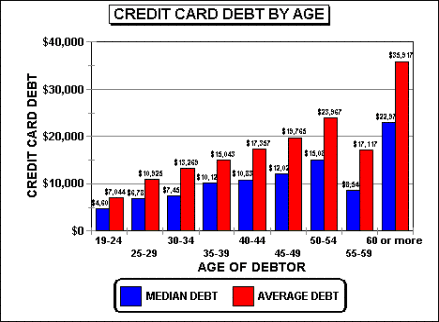
The cost of these plans can be outrageous. They are based on your balance. If you pay off your balance every month, then the plan is free, but carry a balance and you could pay as much as $1.35 per month for every $100 you owe. The average American has a little over $5,000 in credit card debt. That means a plan of this type could be costing you $67.50 per month. Lenders collected about $2.4 billion in premiums last year, but only paid out less than $500 million in benefits. That is close to $2 billion in profit or close to $2 billion wasted dollars depending on your point of view.

Legal Issues

Then there is the legal trouble that several banks have been facing over debt protection plans. Capital One has been fined $210 million for ''deceptive'' practices related to debt protection. HSBC has a $1.3 billion fund set up to repay British customers because they ''pushed customers'' into buying one of these plans. Hawaii has successfully sued HSBC, Bank of America, and JPMorgan Chase for similar tactics.

Your best bet is to skip the debt protection racket and take these steps to create your own ''insurance'' plan: calculate what your premium would be (take $1 per $100 owed) and put that amount into your savings account. Attack your balances by increasing your monthly payments and putting the cards away for 60 days. If you feel the need for life or disability insurance, get a plan from a licensed agent that will cover all of your needs instead of limited coverage for your debts.

This article has been provided by the experts at NorthCarolinaAutoLoan.com.  They help people get approved for auto loans in Wilmington, NC, and across The Tarheel State.  Learn more at their YouTube channel.

Tuesday, July 3, 2012

Guest post: How to manage your business debt


US-PDGov

 By: Mickey Colon

Managing your business debt wisely is a top priority if you want to run your company efficiently. In some cases the debt is tied to the business entity instead of the owner. But even though the creditor can only go after business bank accounts and assets, poor management of the account can negatively affect your business reputation.

In other cases creditors will hold you, the owner or representative, personally responsible for a debtyou accrued while running the business — particularly if you signed a personal guarantee to start the account. Either way it’s important to stay on top of your business debt accounts and make every effort to get them under control.

Create a Business Budget
Whether you’re a large tech conglomerate with over 100 employees or the owner of a small main street flower shop, you must have a business budget in place. Lack of a budget is one of the top reasons why many business owners get into debt in the first place and also why they continue to stay in debt.

Your business budget should accurately list your estimated monthly business income and expenses. That includes employee wages, office rent, office supplies and other costs to operate the business including your monthly debt expense. Your income may vary each month depending on the type of company you run, so estimate the revenue for each month in advance.

Pay Down Plan
Make a commitment to funnel your business profits (income less expenses) to your debt accounts until your balances are more manageable. If necessary, be prepared to make major sacrifices to put your business in a better position debt-wise in the short-term. For instance, you may have to pay yourself a lower wage or no wage at all for a few months until your accounts are paid off.

If you find yourself with a shortfall (loss) or breaking even every month it’s time to make some tough decisions on how to run a more lean and mean operation. In the meantime, avoid continuing a pattern of accumulating debt — if your past expenditures haven’t helped you turn a profit, it may be time to re-evaluate your entire business strategy.

New Habits
Once you get back on track with your business debt, make it a habit going forward to try to pay off your balances before each billing period ends. So for instance, if you charge $1,000 at the beginning of the billing cycle for inventory, make it a point to pay off that $1,000 as soon as you receive the proceeds from the associated sale. This way you avoid interest expenses.

Also, as a savvy business owner you should constantly be on the lookout for a better credit deal. Shop for new business card deals periodically and talk to your local credit union.

Bio: This article was provided by America’s debt help Organization, serving the public with unparalleled content about a range of topics, such as reducing debt, credit card consolidation help, mortgage modifications, planning retirement and helping Veterans get out of debt.

Monday, March 14, 2011

How to Manage Unsecured Credit Cards

Image attribution: U.S. Department of Justice; US-PDGov

To manage an unsecured credit card it helps to first know the five factors that go into your credit score. The Fair Isaac Corporation, creator of the FICO score claims credit history, types of credit, amount of credit, new credit, and credit history all provide a basis for credit calculations. Unsecured credit cards don't have to mean sky high debt or a bad credit rating. Managing unsecured credit cards well uses the same good credit habits that one would use to raise a credit score.

Managing unsecured credit cards well also avoids the more negative consequences of credit card use; this implies there are risks associated with using these cards. Specifically, these risks include interest rate risk, and debt risk. Understanding what credit cards are for is helpful in managing them well; for example if unsecured credit cards are thought of as lifestyle loans rather than an alternative form of payment, chances the cards will be used in excess may increase by virtue of credit intent.

• Debt to credit ratio

As with secured credit cards and when building credit score, using less than 40 percent of the total available balance is usually a good idea. For example, if you have three unsecured credits with credit limits of $1,500 $3,500 and $5000, the total available credit is $10,000. Using $4000 or less of this limit will ensure a debt to credit ratio of .4 or 40 percent. According to the Fair Isaac Corporation, the amount you owe on credit cards affects up to 30 percent of your FICO score.

• Use of unsecured credit

Regular use of unsecured credit cards also builds credit if proper payments are also made on that use. If using credit is not a preference that you feel comfortable with, only use credit enough to build credit as avoiding having to use or rely on credit is often a good idea anyway. Not using credit cards at all shows creditors you are not a low risk or potentially profitable client and may hamper obtaining credit in the future.

• Purchase constructively

What is spent using unsecured credit cards can affect how well you manage them. For example, if you use a credit card to buy a tool or piece of equipment used in a job or business, then that purchase has a potential return on investment (ROI). This ROI may exceed the cost of credit used, if any.

• Make payments

Making payments on your unsecured credit cards is ideally done in full and consistently. On time payments avoid late fees and being reported to credit bureaus. Payment history affects up to 35 percent of your FICO credit score. Making regular payments also demonstrates fiscal responsibility, the capacity to stay within a budget and an understanding that the credit is a temporary loan rather than debt with optional repayment.

• Ask for credit

At some point after using unsecured credit cards for a while you may want to request higher balances to increase your debt to credit ratio. This can increase your credit score and improve interest rates on loans. Asking for more credit should generally not be done until responsible credit card use has been established as measured by the debt to credit ratio and after enough time has passed where this ratio has been maintained i.e. at least a few months.

Source: http://bit.ly/ggXQt (MyFico)

Thursday, February 10, 2011

Pros and Cons of Paying Off Credit Cards With Home Equity Loans

Equity costs less than credit so financing a credit card debt with equity is cheaper. However, there are a few cursory related issues such as capital for home improvements, amount of credit card debt, and refinancing that can make the interest rate benefit not worthwhile.
This article will discuss the various advantages, disadvantages and factors that may assist with the decision to pay off credit card debt with home equity, and then follow up with a few tips that may prevent one from having to use home equity to pay off debt.
Advantages
The larger the credit card debt, the more practical a home equity loan becomes once all other options are deemed unavailable. In other words, if there is no other cost saving solution, a home equity loan may not be such a bad idea.
• Net Gain on Interest Rate Savings: Equity loans and lines of credit cost in range of 5-8% in interest whereas credit cards charge between 9-20% in compounded interest. Depending on the amount of credit card debt one has, this can make a significant annualized difference in savings. For example, if an individual has $7,000.00 of credit card debt at 14%, the nominal non-compounded interest for one year would be $980.00. At 6% through a home equity loan, that amount would be closer to $420.00 nominal i.e. non-compounded.
• Enhanced Individual Cash Flow: With less debt tied up in credit cards, monthly expenses go down all other expenses held constant. This can place one in a better standing with credit card companies and allow for more cash flow with which to manage monthly costs.
Disadvantages
Since homes are often a source of financial security for individuals and family, utilizing the equity in one's home can be a drain on financial assets that may be needed in the future.
• Refinancing causes Re-Amortization of Mortgage: When a mortgage is refinanced to include a second mortgage via a home equity loan, the mortgage amortization schedule can reset meaning the interest payments will likely rise in proportion to capital contributions. The difference between the newly amortized repayment terms and the savings from paying off the credit card debt may be too low to consider.
• Equity leveraging Declines: Should the need arise for a home improvement emergency or unexpected family cost, one may have be required to resort to credit cards once again making the equity loan redundant. In this case, one should assess the potential for future expenses and individual savings and cash-flow to assure the equity loan doesn't use up too much leverage.
Tips on using equity to pay off credit cards
• Negotiate Credit Card Rates First: One may be able to lower the credit card interest rate through credit counseling services or directly with the credit card company. This can save one's home equity and monthly expenses.
• Finance Large Debt: If the debt is large, the potential savings increase than with smaller debt. It may not be worthwhile to take a home equity loan for small amounts of credit card debt.
• Vehicle Collateralize: In some instances, a newer or luxury vehicle can be used as collateral for a loan with more favorable interest rates than credit cards. By considering a vehicle collateralized loan, one can save with a lower interest rate and protect the equity in one's home.
Home equity loans can be a good idea, if the financial circumstances deem them necessary to cut costs and save money. However, it is important to note such loans may not be worth the effort or the cost after mortgage recalculations, unexpected costs requiring future credit card use.
The primary factors one may think about prior to obtaining a home equity loan to pay off credit card debt are the size of the debt, the potential cost savings, future cash flow needs and other lower cost sources of financing the credit card debt pay-off. Should the equity loan still be favorable after such factors are entered into the equation, the loan may be worthwhile.