Pages

Labels

Showing posts with label business finance. Show all posts

Wednesday, January 23, 2013

Tips on how to choose accounting software for your small business


US-PDGov

Years ago, keeping books was a tedious and difficult job which involved tons of papers, pens and pencils, ledgers, and commonly the carpal tunnel syndrome, because accountants and small business owners used pen and paper to record all the financial transactions a business was making. Today, however, things are significantly different. We live in a world where everything moves very quickly, and every minute is important. With the advancement of technology, we have been able to computerize almost every task we have, and this includes bookkeeping.

Why is accounting software so important to utilize?

Well, we will start from the obvious reasons – saving time, saving money, and eliminating the human error factor from the equation of bookkeeping. Aside from the obvious reasons, there are many more reasons related to the performance and success of your business. For example, you can see different trends in your business practice, such as financial reports from the past quarter, your stocks, predictions for the next quarter, and so on.

What should you look for when choosing business accounting software?

Here is a list of things to look for when deciding which accounting software to go for:
  • Price – The first thing to think about is the price. There are some open-source accounting programs available, but it is always better to go for a paid software application. Find one that has a reasonable price and go for it.
  • Ease of use – It is very important that the accounting software you go for is easy and intuitive to use, especially if you have to do your own bookkeeping. There are accounting programs that are very complicated, and there are those that are pretty easy to use. Try a few out and see which suits you most.
  • Features – The features offered by the accounting software you choose will make all the difference in your daily schedule. Namely, not all the programs will offer you the same options and tools, and you should choose the one that has everything you need in order to run your business smoothly and without any hiccups.
  • Ask your staff – If you have accounting staff, you should consult them regarding which accounting software to choose. They might have previous experience with this, and you should also take into account their opinion if they are the ones who will be using this software the most.
QuickBooks 2013 is a very good choice

While you are doing your research you will surely come across accounting software called QuickBooks, and there is a very good reason for this. QuickBooks 2013 is probably the best choice you can make when trying to find the perfect accounting software for your company. This program has all the features you can only wish, and QuickBooks Pro 2013 training will help you master all of them. It is important to know that QuickBooks Pro 2013 is very easy to use and intuitive as well, so mastering all the tools within the program should not be very difficult and shouldn’t take you a lot of time.


About the author: Jack offers Quickbooks pro 2013 training, both for corporates and individual clients. He has been in this field for last 5 years and regularly travels around the world on training assignments.

Monday, August 13, 2012

How the accelerator effect works

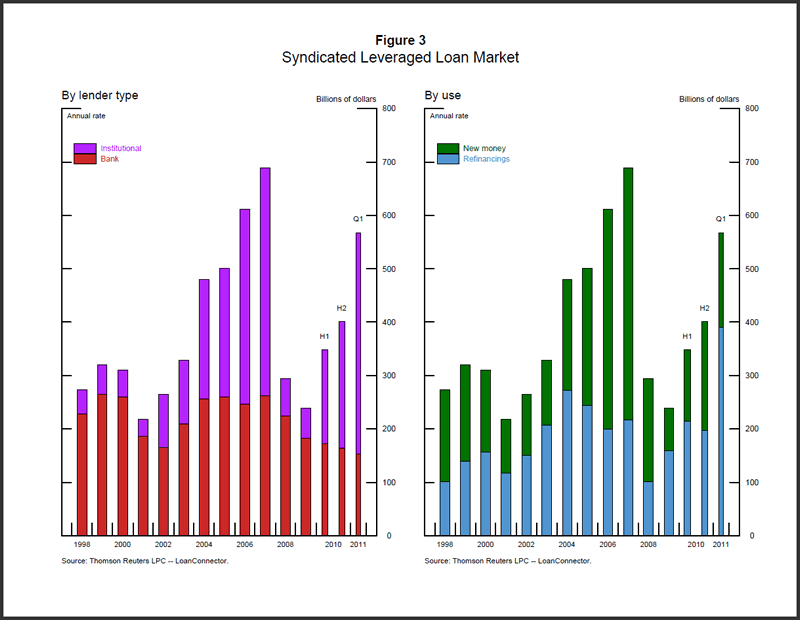
Syndicated leverage loan market 1998-2011 
 Indicates how financial markets coincide with economic conditions


The financial accelerator effect is the outcome financial circumstances relating to business and market outlays have in terms of specific economic conditions. More specifically, according to Ben Bernanke, Chairman of the Federal Reserve Board, the accelerator is itself a change to “financial and credit conditions” that affects the business operating environment. For example, if interest rates rise, the cost of capital also rises; if the business environment is experiencing a down-cycle, then the rising interest rates are thought to accelerate the negative impact of the business down-cycle which in turn influences economic conditions. 

A key function of the accelerator effect is to explain why certain financial conditions occur. When a cause for specific events can be proven to be the accelerator effect, then the reason for fiscal circumstances and actions can be illustrated and justified with more validity. For example, in a research study by an Bruno Coric Phd of the University of Spilt, it is claimed the accelerator effect itself serves as a model with which changes to business “outputs” are related to financial markets. In other words, the accelerator effect is a substantiated economic tool in the context of which economic scenarios are made clearer.

Even though there is some explanatory power to the accelerator effect, it is not completely illustrative of economically related financial scenarios. Moreover, as Ben Bernanke of the Federal Reserve and  Simon Hall of the Bank of England point out, the scenario described as the accelerator effect is not due to unique causes. Moreover, other variables also influence the economy which impact the accuracy of the accelerator effect as an explanatory tool. For example, even if financial obstacles such as access to financing are prevented from inhibiting business operation, there is still the question of how using available money would be profitably beneficial. 

Measurement of both economic and financial impact is also a key function of the accelerator effect. In a report by Amundi Asset Management the accelerator effect is measured by determining the quantitative changes to corporate investment behavior when economic stress is experienced in money supply, loans to firms, credit conditions and employment. To explain further, by gathering economic and corporate data, trend lines or 'financial affects' are measured. When these trends are statistically correlated to preceding and separate but similar economic scenarios, the impact of the accelerator affect can be numerically illustrated and corroborated.

Guidance is another function of the accelerator affect. The more an economic event can be demonstrated to be the accelerator effect, the greater the perceived utility of specific forms of monetary policy become. In other words, the affects of adjusting monetary policies to influence economic conditions are in part substantiated by the accelerator effect. In this context, if the cause of the financial accelerator is inhibited, the consequence in theory would be a reduction in the ability of that financial mechanism to amplify its economic impact leading to a change in the accelerator effect.

Tuesday, July 24, 2012

Guest post: How to maximise your chances of getting government funding for your business

US-PDGOV


By Andrew

Banks and other private lenders are not the only parties to ask for funding assistance if you need financing for your business. There are various state and federal programs that are providing and managing grants or funding allotted to troubled or needy businesses. There are specific government agencies or institutions that are tasked to offer and provide such grants.

Government funding is just out there, waiting for the right business applicants that need financing. But the financial assistance will not be easily and quickly provided to just about any company. The government funding agency has to make sure the money will not be put to waste. It may have its sets of requirements and standards to screen and approve/disapprove funding applications. How can your business maximise its chances of getting funding from any government granting agency?
  •   Write and put up a well defined and clear mission statement for the business. Some people think the mission statement is just for formality but government funding agencies and institutions look at it as a necessary factor especially when granting and awarding government funding. The statement should effectively convey the essence and goals of the business.
  •   Write a good grant letter. It should effectively persuade specific government agencies to consider providing or awarding grant to the company. Some business owners hire experienced grant writers to write the grant letter, which is necessary to complete the grant application or proposal.
  •   Set clearly defined and ideal outcomes for specified projects. The business may be seeking grant funding for particular projects. It should present a projection of how those projects will do well and how those can bring about desired outcomes. Government funding agencies also need to make sure the money they provide to businesses will be returned on or before the specified duration.
  •      The financial systems of the company should be in place to effectively project, show, and track how the potential funding will be spent. Government funding agencies need to make sure there is a sound financial system. This is necessary to protect the funds granted to businesses. Those may decline or refuse a grant application if the financial system of the company is not in good state. 
  •    There should be programs that will ensure overall sustainability of the business. Community projects should also be well presented and should clearly give an idea how those will be used for the advancement not just of the business but also of stakeholders and the communities. Government agencies want to be sure their funding will be well and sensibly spent.
  •     There should be specific actions or measures to recognise and/or honour grant donors. This is not just for flattering government funding providers but to give them what is due to be accorded to them following the grant. 
  •       The business should ensure that it has independent contractors or specific employees who will manage the grant. Those should also be tasked to complete required reports that are required or mandated on a regular basis by government agencies or foundations. 

Andrew has been working in the finance industry for several years with a specialty in business finance. Andrew has a BA in Business Administration and has written numerous articles in prominent finance blogs.

Thursday, March 22, 2012

Why the price-to-earnings ratio is not an adequate valuation metric

The price to earnings ratio is often used as a measure of corporate performance and overall market performance via the P/E ratios of whole indexes. If the ratio is low in comparison to previous levels then the market is sometimes believed to have room to rise even if it is already inflated. For example, market analysts and observers such as StockCharts.com illustrate this point. Moreover, since 82 percent of companies that reported Q4, 2011 earnings had GAAP vs Operating P/E ratios that were in-between 15 month highs and lows, then those companies are believed to be fairly valued per Stock Charts.

Even GAAP or Generally Accepted Accounting Principle Price to Earnings ratios can be misleading however. This is because it measures earnings and not revenue. Earnings are what are left after a company deducts outflows such as expenses, and dividends. So if revenues decline quarter after quarter, but earnings rise relative to price via cost cutting, then it will appear as though the company is becoming cheaper. For example, ABC Corporation earns $100 million on 5,000,000 shares in Q3, 2011 and has a share price of $300 giving it a P/E ratio of 15. Then in Q4, 2011 ABC Corporation increases earnings to $125 million by laying off 625 workers at 40k/yr; the price rises to $325/share and the P/E ratio drops to 13 making it seem undervalued.

Clearly the above corporation is questionable investment if it has to lay more people off to stay profitable. The price to earnings ratio does not measure underlying financial conditions.  But that's not all, if cost cutting has already been tried, and that option is no longer available because it would actually cause earnings to decline, ABC Corporation can also reduce the P/E ratio by purchasing existing shares or issuing new shares if the price per share declines. To illustrate,  if ABC corporation purchases 1,000,000 shares in Q1, 2012 and both earnings and share price remain near their $125 million and $325 levels, the P/E ratio then drops even more to 10.4. All the company did was shrink its own shares outstanding.

Wednesday, April 27, 2011

Benefits of Listing a Company on the Stock Exchange

Image attribution: Freedigitalphotos.net; standard royalty free license

 Registering a business to be listed on a stock exchange does not necessarily require the business to be a huge billion dollar equity company. This is so as laws that enable smaller businesses to offer stocks on secondary exchanges such as the Chicago Stock Exchange or Arca Exchange allow those companies to remain private. 

Smaller public companies that wish to be listed on a stock exchange but do not meet larger exchange requirements may also have the option of listing on regional exchanges. If a company is private, the small corporate offering registration (SCOR) requirements within U.S. States is a specific form of stock offering that facilitates remaining a private company while still being able to gain access to stock exchange listing. The listing requirements and benefits vary form exchange to exchange, however finding and registering for an appropriate exchange may be well worth the cost for a number of reasons outlined in this article.


Listing requirements

Each stock exchange has different listing requirements such as historical earnings bars, share volume and stock capitalization value. These requirements may be determined by a Board of Directors and/or Executive group. Generally, the larger the exchange, the higher such bars are set but this does not necessarily exclude smaller businesses from being listed on an exchange. Rather, it determines which exchanges smaller businesses may have the opportunity to become listed on.

To illustrate, the Nasdaq stock exchange requires a minimum earnings of $11 million over three consecutive years prior to listing in addition to a minimum of one and a quarter million share float. By contrast, the Chicago Stock exchange has a tiered structure of requirements defined in part by business asset value. For example, a business with $4 million in assets must have net income of at least $400,000 in the last two years and share capitalization of $300 million for 500,000 shares with a minimum of 800 shareholders or 1 million shares with a minimum of 400 shareholders.

Benefits of listing on a stock exchange

Being listed on a stock exchange has many advantages that a business owner of any size might consider as part of a businesses strategic plan. Moreover, when expansion and leveraging are on the business agenda, stock exchange listing can cast a wider net into the capitalization pool i.e. the potential sources of equity funding. A few of the benefits of stock exchange listing are illustrated below.

• Market exposure

Through listing on a stock exchange a company is gaining market exposure to a broader membership of the financial community including market makers, buyers, sellers, and institutional traders, mutual funds and possibly hedge funds. Consequently, if a business is worth investing in, the listing opportunity has the potential to greatly increase capital investments. In other words, as opposed to private negotiations and networking, a listing on an exchange facilitates exposure to a larger financial market and wider range of investors.

• Advertising via market listings

Another benefit of listing a business on a stock exchange is the complimentary advertising that is included in the filing fee and registration. While this advertising may not be direct, the listing of a business on the exchange affords a business advertising through association. In other words being associated with the exchange and listed on it, a business is in effect advertising itself indirectly if not directly. What's more the cost of registration may be a good bargain because not only does it provide market exposure and advertising but the opportunity to generate capital investment.

• Improved brand equity through listing

Being listed on a stock exchange means that a business has met qualification standards set by the exchange. This can add credibility to a business and therefore brad equity, i.e. customer and/or client perception of value in a company and/or its products. Furthermore, in addition to the credibility resulting from the indirect endorsement from the listing, financial information and investor public relations may also be enhanced through contact information made available through the exchange listing.

• Potential for increased capitalization

A need for capital investment should be one of the main reasons a company lists on a stock exchange. Otherwise it might not be worth the time to be listed for the sake of advertising alone. Stock market listing is one of several sources of capital leveraging, but also happens to be one of the widest and most accessible forms of investment for both investors and businesses. It is largely in effect, a free market for buyers and sellers to meet, assess and trade capital for ownership and vice versa.

• Lower reliance on venture capital firms and debt financing

The potential for increased capitalization through wider market exposure may also reduce the need and reliance upon alternative sources of funding such as venture capital firms. This lower reliance for alternative sources of financing may improve negotiating leverage when obtaining financing from venture capital firms whether it be through less liability protection as determined by the stock ownership terms or lower cost of capital. In other words, if the market exposure gained through listing is positive, the effects on financing can also be positive.

To summarize, listing a business on a stock exchange may be a good idea for a business seeking improved market awareness, greater potential for capital investment, enhancements to brand equity and negotiating influence etc. Listing on an exchange should probably be in line with or in accordance with business strategy, otherwise the listing may be premature or unnecessary. Nevertheless, for companies that do seek stock exchange listing, the opportunity is there through multiple regional and national stock exchanges and different choices regarding business status and registration requirements with the Securities and Exchange Commission.

Sources:

1. http://www.chx.com/content/Trading_Information/Listing_standards.html
2. http://www.nasdaq.com/about/listing_information.stm
3. http://www.cftech.com/BrainBank/FINANCE/USStockExchs.html
4. http://en.wikipedia.org/wiki/Stock_exchange

Thursday, April 14, 2011

Things to consider when investing venture capital

Becoming a venture capitalist requires lots of money, as start-up companies look to this source of financing as an alternative to business loans and other forms of debt. So naturally the first step is to acquire access to a large amount of funding either via personal wealth, financial leveraging, or business collaboration.

Venture capitalists combine investment capital with business knowledge to yield potentially soaring returns on their money. Anyone with financial know how can become a venture capitalist, but to be a successful venture capitalist involves a few important variables. This article will discuss those variables and also provide tips that can be useful to existing and future investors and venture capitalists alike.

• Raising Capital

For venture capitalists who are still not venture capitalists, but want to become venture capitalists takes financial savvy and business astuteness. One can either start out small turning over investments every few months with increasing profits or successfully influence a benefactor that one's venture capital choices will yield a better rate of return than any of that benefactor's current investments. Other sources of venture capital include savings from employment, capital gains from investments or loans from private sources.

• Business Valuation

Valuation of businesses is a key part of any venture capital investment. Venture capitalists must know how much a business is worth, especially if a majority ownership position is being taken in the company. To properly value a business involves forecasting, analysis of financial statements, understanding economic and market conditions such as supply and demand, regional variances in costs, logistics, asset management structure and so forth. Essentially each operation within the business should be assessed from bottom to top to arrive at a fair market and/or negotiable price per share in a business.

• Risk Assessment

Since many new businesses fail within the first 5 years of operation, a statistically verifiable risk exists with most if not all venture capital investments. Such risk involves competition, capitalization, managerial problems, overhead costs, marketing concerns and any unique factors specific to the type of business. For example, if the new business involves a recent technology, determining if all the bugs been worked out or if a high percentages of sales will return for warranty maintenance can have an impact on both business brand equity, labor costs and working capital management. Knowing and accurately predicting these things can help reduce the risk of a venture capital investment.

• Investment Strategy

Investment strategy comprises all the necessary steps utilized in achieving the long term objective of garnering an optimal return on one's investment. Investment icons such as Warren Buffett and George Soros and Richard Branson are all very skilled and knowledgeable business investors whose investment styles can be used as models for any venture capitalist seeking to model one's strategy on that of the professionals. Furthermore, investment strategy is the model by which investment success can be achieved. Such models may include factors such as entry strategy, exit strategy, negations terms, assessment of both ownership and managerial integrity among many other financial considerations.

• Tips for Becoming a Venture Capitalist

1. Know how to walk away. Some deals are just bad, not worth more time or money than is available and are doomed to fail. If one has already invested by the time such knowledge comes to bear, failing to not hesitate could cost more than one would like to lose.

2.  Develop a financial third-eye. All good investors have a business sense, a financial intuition and a know how to see an opportunity before the majority of other investors see the same opportunity. If one already has the business third eye, then develop it through knowledge, if one doesn't have it, learning to simulate it may help.

3.  Don't Panic and Persevere: If things don't always go according to plan, don't worry, even the best investors lose from time to time.

4. Dedicate: Over investing or speculating can cause one to lose site of one's investment goals. Keeping the eye on the ball and only investing in things one is completely sure about, confident in and knowledgeable about can make a difference.

5. Pay Attention: Missing important details and distractions can be all it takes to turn an investment sour. Since business is about profit, small oversights in profit margins, cost estimates and other forecasts can make the difference between a capital gain, a flat investment or capital loss.

Venture capitalism may sound fun and exciting but there is some skill to it. Simply throwing money around into businesses is one thing. Investing for maximum capital gain is another. Skilled venture capitalists like and know what details are important and maximize on them. The above information and tips illustrates some of the key variables used by and inherent to venture capitalists. Becoming a venture capitalist may take time especially if one is starting from the bottom, but it is achievable.

Tuesday, April 12, 2011

The eifference between debt and equity financing

Companies use debt and equity financing to leverage capital expenditures, project development and operational expansion. Without leveraging company's financial growth is limited to retained earnings. For this reason debt and equity financing are often times considered vital to business expansion. Both debt and equity financing have advantages and disadvantages associated with them. This article will illustrate both forms of financing then come to a reasoned conclusion as to when and why each form of financing can be valuable.

Debt sources of financing

Debt financing includes collateralized bonds, debentures, business loans from banks, and lines of credit. Generally debt financing comes with an interest rate somewhere between 3-8% depending on the type. For this reason debt financing can be less expensive than equity finance depending on the expectations of the equity financiers. Debt financing may not always generate enough capital to perform intended business projects and goals as this type of financing tends to be more conservative in its lending requirements.

Equity sources of financing

When using equity as a source of financing a company is seeking capital from investors through the issuance of shares. These shares can be common or preferred i.e. having voting rights or priority in the case of company liquidation. Equity financing can also take the form of employee stock options which replace direct pay in the form of a corporate benefit. In the case of common and preferred shares, equity financing can be variable based on stockholder expectations and type meaning the higher the expectations, the higher the cost of financing.

Advantages and disadvantages of debt and equity financing

In business, both debt and equity financing have their advantages. Debt financing from financial institutions is subject to formal approval from lenders and monitored by organizations that rank the quality and credibility of corporate bonds. For this reason, debt financing can not only be a source of cheaper leveraging, but also an indicator of how viable a projects and goals actually are in terms of how convinced lenders and analysts are about the quality of the debt.

On the other hand, in a competitive market place, venture capital and equity financing can mean the difference between innovation, market share and a competitive edge. Often, such ventures can have more risk and therefore demand more return on investment making the financing more expensive. Nevertheless, if a business can garner a return on capital greater than the cost of goods and services including equity costs, then those projects become profitable.

Depending on the type of business, competitive ventures requiring excessive equity financing may simply be unnecessary, impractical or not in accordance with the goals of the business owners. In other words, not all businesses are designed to rapidly expand and yield growing profits on an annual basis. Businesses that simply intend on yielding a steady profit on an annual basis may benefit more from debt financing because of its structured and cost effective nature.
In the case of Equity financing, businesses that lack credibility, start ups and rapidly expanding businesses however may make positive use out of equity financing not only because it may be the only source of capital around but because it can provide the leverage necessary to accomplish the corporate vision.

Summary

Financing is a form of leverage not uncommon to most businesses in one form or another. Smaller businesses tend to use less, fixed or no equity financing due to corporate goals, cost of financing and business size. Contrarily, large high-powered industry leaders and high growth firms may find it essential to raise capital through equity financing to accomplish annual forecasts, corporate goals and owner objectives. Each form of financing has its advantages and disadvantages as this article has illustrated, but in the end financial leveraging is something that may be required for business survival and profitability regardless of cost.

What Debentures Are

Debentures are financial instruments used to raise capital that offer borrowers the chance to finance their business without forfeiting control of company ownership. Issuers of debentures are typically either government agencies or businesses, and debentures are also referred to as bonds. However, these types of bonds are' un-collateralized' i.e. not secured by collateral assets, making their success in generating funds largely dependent on the credibility of the issuer, and the return on investment to the lender.

• Purpose

Debentures are an alternate source of capital investment financing. They may however, be used alongside other types of financing to better suit the borrowers goals. For borrowers debentures help finance projects, business expansion and operational objectives that are believed to contribute to their organization's financial success. Lenders partake in debentures because they can receive a stable growth of investment in the case of high-grade debentures, while also hedging risk from other investments such as stocks.

• Terms

The borrower and lender terms of agreement that circumscribe the bondholder's rights are called 'indentures'. These are legal loan contracts that define how the debentures will be paid back, the time by which this will happen, how the debentures will be beneficial to the lender and any other requirements, restrictions, waivers etc. that the involved parties agree to. The process with which debentures are issued and sold is called underwriting; in some cases this process may involve third parties such as investment banks.

• Interest

Interest rates or borrower costs vary considerably with debentures but can be as high as 25% or higher.(3) The indenture, financial solvency of the issuer, and the market in which the debentures are exchanged influence the rate debentures yield. Essentially, the higher risk the company and the more restrictive the indenture is, the greater the interest rate should be to compensate for the accompanying risks to the lender.

• Types

Several types of debentures exist, not all of which are available for consumer investments.(1) Agency debentures are government debentures according to Investopedia, whereas corporate and convertible debentures are issued by companies; the latter of these can be converted to equity i.e. shares. Not all debentures are subject to the same lender obligations, an example being subordinated debentures that do not give priority to the debenture holder in the event of corporate insolvency.(3) Other types of debentures include redeemable and mortgage debentures.(5)

• Benefits

The benefits of debentures may include both a high and relatively low risk return on investment (ROI) for lenders depending on the type of debenture. In other cases, the interest paid by the debenture may be fairly low as is the case with several types of Government debentures. Mutual funds that invest in bonds may offer investors an opportunity to invest in debentures that would otherwise be inaccessible. The benefits for corporations generally assume an Internal Rate of Return (IRR) that is forecasted to be higher than the cost of the debenture(s) in addition to achieving business developmental or operational goals.

Sources:

1. http://bit.ly/9Vdpsy (Treasury Direct)
2. http://bit.ly/8Zy8YH (Investopedia)
3. http://bit.ly/d7lTAl (Mojo Law)
4. http://bit.ly/ax7dYP (Small Business Administration)
5. http://scr.bi/bdqA1z (Scribd)

Tuesday, April 5, 2011

How Banks Analyze A Company For Loans

Since banks' profitability is partly determined on how well they analyze corporate loan applications, the company loan application is quite relevant in banking risk management. To help the bank determine company viability and capacity to repay a loan, many financial, operational, market and economic factors are weighed into the loan application and company analysis. 

This article will discuss these factors. Section I will discuss the relevance of bank policy and loan criteria. Section II will go into greater detail about the specific items banks look at in analyzing and assessing corporate viability. Lastly, section III will discuss the analytical tools used by banks in evaluating company performance and qualification.

Bank policy and loan criteria

Bank policy is the framework within which loan applications are considered. The first step in a company loan application is compliance with the banks policy. Otherwise could immediately disqualify a company from qualifying for a loan and bypass the company analysis altogether. An example of bank policy in regard to company loan applications are the type of companies and company loans the bank provide. Moreover, some banks specialize in specific types of business loans only, making loan applications outside this criteria invalid. Moreover, the bank policy may also outline different analytical criteria dependant on the types of loan.

The bank officials' skill and carrying out of bank policy is also important in the loan application process. Loan officers often follow pre-determined criteria for approving loans and understanding these criteria is helpful if not essential in understanding how banks analyze company loan applications. Thus, the loan criteria are the broad requirements that a loan application must comply with to be considered further. The steps of loan analysis can vary but generally follow specific instructions and criterion.

Company performance factors

Financial strength from revenue, cash-flow and project management, streamlined operations, competitive positioning, financial ratios and corporate valuation are just a few of the items a bank may look at when considering a company loan. Other factors include the size of the loan, existing debt, credit history, loan use, business plan, application quality and applicant presentation. These are a lot of things for a busy business manager to consider in order to obtain bank financing, but it is in a nutshell, how banks manage their loan risk. Examples of a few of the specific qualifiers a bank may measure are below:

•  Company ability to provide all required documentation
• Debt level below a percentage of total average annual income
• Debt level below a percentage of company asset value
• Potential and probability of loan to facilitate profitability
• Credit history, and credit score
• Banking history and assets held within the bank
• Proven company compliance with government tax code
• Compliance with loan terms and agreements

The bank itself is yet another factor in how a company is analyzed for loans. This is so as different banks may have varying loan requirements, expectations, risk structure, bank policy, financial environment, economic forecasts, liquidity etc. These underlying factors are likely to influence how a bank analyzes a loan application in the sense that it predisposes the bank to either be stricter or more lenient on some aspects of loan applications.

Analytical tools used by banks

Without analytical tools a bank official would have little means by which to determine if a company's loan application meets company performance factors as required by bank policy. Several analytical methods and tools are listed below as sourced both independently and from http://commericalloananalysis.com . These tools are used by banks and taught to bank officials so they are better able to accurately determine the viability of a company in its ability to repay a bank loan.

• Ratio analysis
• Cash-Flow analysis
• Operational risk assessment
• Bookkeeping evaluation
• Breakeven analysis
• Forecast and probability measurement
• Multivariate analysis

Each of the above analytical tools is designed to measure different aspects of a business' performance. Since no one metric is able to provide a complete picture of a company's valuation, ability to repay, credibility, profitability etc. multiple analytical tools must be used. 

Definitions of each of these analytical metrics can be found by performing a keyword search for each term. For example, to learn more about the different types of ratios used in banking analysis of company loans, the keyword ratio analysis can be typed into a search engine search bar. Additionally, calling a bank's loan department and asking if they can provide information on loan assessment criteria can help a company better prepare for and meet the loan application criteria.

Sunday, April 3, 2011

Understanding Private Stock Offerings

Private stock offerings, also known as equity financing is the issuance of share ownership of a business or corporation through the offering of stocks through private sale. When a business entity decides to issue stock it is attempting to expand ownership and/or raise capital for business ventures. A stock offering is different from an incorporation share structure which is established when a company is formed.

Depending on the type of business the share structure may be initially limited to 100 shareholders or less in the case of a S corporation or more than 100 shareholders in the case of a C corporation. However, the number of shareholders does not necessarily have to equal the number of shares and often does not. Limited partnerships, as opposed to general limited liability partnerships may have shareholders who have only partial liability protection in relation to general partners and the number of shareholders is limited by the number of partners which tends to be quite small. 

Cross referencing share structure requirements with share offering allowances can help avoid confusion in the offering process, but generally speaking C-Corporations are the least likely to experience complications regarding number of shareholders.

Types of private stock offerings

There are three types of private stock offerings used in the United States. These are the "Private Placement Memorandum (PPM), Limited Partnership Offering (LPO) and the Small Corporate Offering Registration (SCOR)" (www.cfss.com)

The Limited Partnership Offering is designed for businesses structured and incorporated as limited partnerships and therefore this method of stock offering may not be utilized by S corporations and C corporations.

Small corporate offering registrations vary from state to state depending on state laws and procedures. Currently not all states allow this type of offering but a large number of states do. This type of offering is quite flexible in that it allows sale of stock to any interested persons rather than just "accredited" and "unaccredited" investors.

Investor accreditation is important in the Private Placement Memorandum offering which limits the number of potential investors to those with high personal wealth, experience and knowledge in the purchase of stocks and potential risks. A limited amount of additional investors are also allowed in this type of offering but they too must pass certain knowledge requirements. There are also restrictions on the amount of capital that can be raised using this method and how many times a year stock offerings can be made.

How to offer stock privately

Although issuing private stock is more simple than a public stock offering there is a fair amount of due diligence, careful though and preparation that ideally goes into the decision and process of issuing private stock. Knowing one's business inside and out, its needs, the effects of a stock offering, risks and benefits are all important factors to weigh. Additionally, understanding the process, and requirements can not only help a business owner or owners determine whether or not they require outside assistance, but also how much of that assistance may be necessary. The following is a general guideline of the some of the steps involved in private stock offerings.

• Incorporate the company as a partnership, S-Corporation or C-Corporation
• Become familiar with financial goals and capital requirements 
• Familiarize with the three types of stock offerings i.e. partnership, small business or C-Corporation
• Assess liability, legal and management risks and incorporate this into the decision making process
• Consider the benefits of legal counsel or business consulting services
• Create a detailed prospectus that includes stock, financial, legal, and business information
• Prepare additional paperwork, sale and recording items.

Advantages of private stock offerings

There are several unique advantages to issuing private stock. Most notably, the great amount of capital infusion into a business that has the potential to be cheaper than bank loans or other forms of debt financing. Some of the benefits of private stock offerings are listed below:

• No Securities and Exchange Commission (SEC) registration required
• In the case of SCOR offerings, stocks can be resold in stock exchanges
• Capital generation and infusion into the corporation
• Less publicity of corporate financial records, strategies and operations
• Taxation of earnings may be limited to shareholders

Disadvantages of private stock offerings

There are also potential disadvantages to private stock offerings, specifically in some cases liability, decline in the value of stock and therefore equity capital, and greater management accountability.

• Loss of complete ownership
• Increase in paperwork, and accounting record keeping requirements
• Increased responsibility to shareholders
• Dividends may be a requirement and/or expectation of investors
• Potential for lawsuit in some instances of business malpractice

Choosing to issue stock privately can be a big step in a businesses growth and is a decision that is left in the hands of the business owner(s). This decision may be best thought out carefully in terms of business goals, objectives and profitability. Understanding potential liability risks and benefits to the business in addition to the requirements and changes to the business operation that are subsequent to the offering are important. The information in this article provides a brief acclimation to the private stock offering process and may serve as a starting point or reference to the procedure of private stock offering and various attributes pertaining to it.

Sources:

1. http://www.jbv.com/lessons/lesson24.htm
2. http://www.cfss.com/stockofferingbasics.htm

How Vendors Can Help You Fund Your Business

Vendors have a vested interest in the success of their clients and thus are likely to be supportive or understanding of clients' financial needs. This aspect of the vendor/client business relationship positions vendors in unique positions to assist with financing business cash-flow and working capital needs.

Since vendors are also suppliers of wholesale products and in some cases are also franchise shareholders of businesses, there may be several ways by which they may be able to help finance a business. The following illustrates types of client/vendor relationships, how those relationships can influence financing and the various methods of financing assistance vendors can provide.

Franchise vs independent business

Vendors may also be franchise partners or owners meaning their stake in the business' performance is considerable in terms of capitalization, supplying, managing and branding. For example, McDonald's franchise owners are subject to licensing requirements held by the franchise supplier i.e. McDonalds Corporation. The terms of that licensing relationship may include explicit financing assistance and/or terms.

In the case of independent businesses, the relationship with vendors may not as strong but still important. If a business has had a long standing relationship with a vendor that vendor may be more than willing to assist with financing in a number of ways. Depending on the size of the vendor and the nature of the business, they may even have their own banking division.

Vendor financing methods

• Advertising 

Vendors are companies too, therefore any advertising a client business can offer the vendor is worth money to the vendor. In return for certain advertising, vendors may offer deals which may include but not be limited to financing arrangements, discounted supplies and/or favorable business terms.

• Loans 

Large, heavily capitalized, nationwide vendors may also own financing companies that act as subsidiaries in the interest of the parent corporation. An example of a financing subsidiary and/or shareholder relationship is GMAC financial services as owned in part by General Motors Corporation. In the case of GMAC, financing is and was made more available to vehicle buyers and vehicle sellers when the need arose. Vendors with or without ownership in financing firms or subsidiaries, may be willing to assist in offering loans and/or capital for financing a business not only as a profit venture, but as a means by which to facilitate the vending, distribution and sales of their primary business of supply.

• Equity Investment 

A vendor corporation may also be interested in becoming a shareholder or partner depending on the type of business the client operates. This allows vendors both greater influence in the managing of a business, but also a potentially mutually beneficial business relationship in which the business owner becomes better capitalized, and the vendor acquires profit potential and/or greater continuity in vending supply.

• Supply Terms 

If a company uses a cash basis of expensing, money becomes due upon receipt. In the case of inventory on a cash basis receipt, this can involve significant up front expenses. Due to this, many suppliers and/or vendors offer credit accounts in which payment is made after delivery of a product. These terms may be negotiable in terms of interest, time periods and wholesale prices.

• Business network 

Vendors themselves may acquire financing from banking and/or venture capital investors. If the vendor has confidence in a particular business, they may be able to provide a referral or recommendation for either loan or capital financing.

The vendor/client business relationship can be a strong one. It is for this reason that vendors may be unique sources of potential financing of a small business. Depending on the extent and type of the business relationship a client and vendor have, there are several mechanisms by which financing can be achieved. These methods of financing include but are not limited to direct financing, service barter, negotiation of business terms, capital and/or equity investment and financing referral.

Tips For Finding Angel Investors

Seeking capital for a new or start up business? Angel investors may be just the thing you're looking for to implement a strong business plan. Angel investor financing is an alternative to personal business financing, bank business loans and venture capital. Typically, angel investors are wealthy individuals who seek out business related investment opportunities with potential for high growth. Angel investors don't just lend money to anyone as a true angel might, but usually discern what to invest in based on a number of criteria. Some of these criteria are listed below:

• Industry specific businesses ex-New technology
• Sound business plan and model
• Effective managerial team
• Innovative and knowledgeable business participants
• Credible and capable fund seekers
• Potential for growth i.e. Return on Investment (ROI)

Where to find angel investors 

Angel investors can be found through specific venues and sources. Some of these sources may charge a fee to help match businesses with investors whereas other venues may have a direct application procedure. A few sources for finding angel investors include start up company networks, angel investment fund organizers, and government equity financing. There is a great deal of money available from these and other sources and finding these sources is relatively easy. Additional resources for finding angel investors include the following:

• Angel investor facilitation services
• Investment seminar networking
• Business networking groups
• Angel investor groups and organizations
• Lawyers who work with angel investors and/or prepare capitalization documents
• Business classified sections of financial newspapers

What angel investors look for

Since angel investors are placing their capital in unproven businesses, they may invest through limited liability corporations (LLC's), trusts or non-partnerships so as to protect their personal/non-investment assets from liability should their investment ventures fail. Angel investors are look for ways to grow their money not lose it. This means the businesses they invest in should be able to return a sizeable yield on investment. What's more, depending on whether the angel investor belongs to a group or fund of angel investors, the procedure for acquiring capital may vary.

In some cases applications similar to business loan applications may be utilized to obtain funding while in other cases, an angel investor may agree to finance after having reviewed the business plan and ideas personally. Since angel investing is a unique form of financing less subject to banking regulation, the criteria and rules for obtaining angel investment funds can be diverse. Angel investors are located in many cities and contribute to the liquidity of a business and growth driven economy. If an business person has created one or more successful businesses in the past and is seeking financing for a second or third time, the process of obtaining equity capital may be easier due to 1) familiarity with the process, 2) connections within the investment community and 3) a proven track record of business success.

Angel investors don't just give money away, they seek a financial instrument as collateral for investment. Such financial instruments may include convertible bonds, common stock, preferred stock or revenue and/or earnings sharing mechanisms. The financing terms are detailed in financial contracts, share structure documentation and/or debt issue instruments such as indentures and debentures. In any case, few angel investors are likely to simply give money away to non-charitable causes and/or businesses that have an estimated high chance of failure.

Summary 

Finding angel investors is the process by which new businesses obtain capital in exchange for a stake in the future earnings and/or revenue of those businesses. Angel investors can be located through a number of means and sources including physical networking at investor events, known angel investor collaborators, angel investor organizations or funds, and the angel investors themselves.

The search for angel investors is a process in and of itself but may only be fruitful if the fund seeker(s) have a viable and competitive business plan for the use of the angel investor's funds and are willing to share in the potential growth of the company in which the angel investor invests. This article has illustrated the concept of angle investing in addition to the various sources at which angel investors can be found in addition to what angel investors may look for when financing with their money.

Sources:

1. http://www.smallbusinessnotes.com/financing/angelinvestors.html
2. http://www.gobignetwork.com/http://fmangelfund.angelgroups.net/
3. http://www.angelcapitalassociation.org/
4. http://www.sba.gov/services/financialassistance/equitycapital/index.html

Saturday, April 2, 2011

Types of Tax Breaks For Small Businesses

Tax breaks reduce taxes owed to a government by an entity such as a small business. Different types of tax breaks for small businesses in the U.S. come in the form of tax deductions and tax credits and include a wide range of expenses and expenditures incurred by a business. The reason why the various types of tax breaks for small businesses are so useful is because they 1) reduce or eliminate taxation of business operating expenses and 2) can help preserve business retained revenue. The remainder of this article will outline business tax breaks and the process by which they are sometimes claimed.

Deductible business expenses

Amount the types of tax breaks available to sole proprietorships, LLC’s and partnerships are business expenses. These expenses take the form of deductions to taxable income which means a smaller amount of income will be taxed at a given tax rate after the deduction is granted. An example of a deduction available to sole proprietorships, S-corporations and partnerships are expenses for 1) licenses and 2) interest.

Tax deductible business expenses are costs incurred in the operating of the business, and are subject to specific tax regulations that should be complied with  before claiming the deduction. Even though some business operating costs are deductible doesn’t necessarily mean they are worthwhile expenses because the tax benefit is only a fraction of the actual cost. For example, if a business purchases a new antique diamond studded office fish tank for $10,000 thinking the cost can be written of through taxes, they may be in for a surprise. That office expense may not only be non-deductible; and if it is deductible may only reduce cost by the 15%-35% tax rate, or $1,500-$3,000 which that business is taxed.

Business tax credits

Being aware of the available types of tax credits is a good step in both tax planning and strategy in addition to tax filing. Not claiming tax credits can be costly to a business making the time and research used in becoming cognizant of  business tax credits potentially worthwhile. As with business expenses, identifying which IRS forms and publications apply to a specific business is helpful in identifying the most clear business tax credits qualified for. A few places to start looking for business tax credits are listed below:

(1) IRS Business Tax Credit information page
(2) U.S. Code on Tax Credits
(3) Tax strategy review
(4) Offshore business tax strategy
(5) State Departments of Revenue

Types of tax credits for small businesses may also be added or eliminated with changes to legislation in each new tax year. Generally, these changes to the tax law are updated by the IRS through edits on the relevant tax forms. However, it can be helpful to be familiar and up to date with available tax credits in case they are not clearly marked on the standard business tax return forms. Additionally, even though a space may be present on the Form, the information about the tax credit may be in a different IRS publication. For example, on the 2009 Form 1120-S is a line for other credits on line 13g. This line refers the tax filer to the instructions for form 1120-S. Thus, taking the time to read and be aware of multiple source on business tax credits may be beneficial to business retained income.

How to claim business tax breaks


Business tax breaks vary between the business types; for example, sole proprietorships are not necessarily subject to the same tax benefits as a partnership or limited liability corporation (LLC). So accordingly, an important step is determining the type of business for which the tax breaks are for. Each business type has different tax forms issued by the U.S. Internal Revenue Service (IRS). For example, an S-Corporation or small business is required to complete a Form 1120-S.

Step 1: Identify business type
Step 2: Locate correct tax forms
Step 3: Assess and research tax breaks 
Step 4: Apply tax break(s) to business tax return

The business tax forms that may be required include (1) Form 1040 Schedule C for sole proprietorships, (2) Form 1120-S for S-Corporations, (3) Form 1065 for business partnerships, and (4) Either a Form 1065, Form 1120, or Form 1040 Schedule C, depending on the type of LLC. For example, a limited liability corporation may have only one person who owns the business and who fulfills all the executive roles which may require the 1040 Schedule C be filed rather than a Form1120-S. The following link provides a more complete list and illustration of LLC tax filing classification.

Source: http://www.irs.gov (U.S. Internal Revenue Service)

How to save money running a startup

Knowing how to save money running a startup not only helps the competitiveness of a business, but can also benefit the business owner and the valuation of the business itself. Cost management is an essential aspect of business management especially during times when revenue is lower, and affordable business financing is harder to come by.

The startup money saving tips in this article target key areas in a business including  (1) administrative costs, (2) operational costs (3) financing costs, and (4) overhead costs. Lowering costs can also be considered in terms of whether or not the cost is recoverable or non-recoverable. Non-recoverable costs are expenditures that can be recovered in part or in full as assets. Non-recoverable costs on the other hand cannot be recovered except indirectly in the form of sales.

• Pass through business structure and tax deductions

Sole proprietorships and S-corporations are pass through businesses meaning income and expenses from the business pass through to the owner(s). By setting up one of these businesses, any qualifying expenses from the business can be used to reduce personal taxes as well.  In this sense, proper allocation of costs ends up saving money on taxes for the owner through running the startup.

To illustrate the advantages of pass through businesses a hypothetical example of Mr. Jones a consulting agent is used. Mr. Jones owns a consulting company that's revenue is $80,000 for one year. Mr. Jones decides to purchase a vehicle and deducts it as an expense from his business income because he can't deduct it from personal income. Thus, if the vehicle costs $25,000, the total remaining taxable income is only $55,000 instead of $80,000. 

In addition to company asset deductions, by qualifying for home office deductions, a startup business can save money on the cost of rent or mortgage costs per proportional use of living space used for business operations. This is another tax benefit of earning money through and utilizing a business for a higher retained income. For example, if 20% of rent is a home office deduction and the rent is $1000, $200 taxable at 25% is $50 in savings assuming the business is profitable enough to benefit from the deduction.

• Energy efficiency and Overhead savings

Money can also be saved running a startup with lower overhead costs. Overhead can comprise a large portion of a non-recoverable business expenses; finding ways to reduce these costs can potentially have dramatic affects on liquidity, and asset value. The more costs that don't increase a startup businesses value, the less profitable and valuable a business becomes. Anything that maximizes efficiency and lowers cost without negatively impacting revenue is probably a beneficial cost savings and utilization technique.

1.  Mortgage commercial property
2. Reduce square footage with vertical usage of space
3. Adjusting lighting: High efficiency lights have the same output for less 
4. Operate business in a lower cost
5. Install self-generating energy equipment
6. Lower storage requirements with supplier shipping

• Non-overhead expense reduction techniques

Non-overhead startup costs are those costs associated with running specific tasks within the business. For example, if a telephone is used to set up appointments it is a non-overhead costs. Reducing these costs without hampering the functionality of a startup business is another way to improve a business' competitive positioning, efficiency and profitability. Whenever considering a cost, it can be helpful to ask if it is available elsewhere for free or lower cost, how essential it is to the business and what can be used as a lower cost alternative.

1. Store information digitally
2. Use an online fax and web based telephone
3. In-source services with existing staff
4. Market via the internet and word of mouth
5. Obtain marketing research via low cost contract

• Financing

Cash flow and necessary equipment are important aspects of a start up business. Knowing how to save money running a startup business can also be achieved by adjusting cash flow and equipment financing.  For example, by combining a line of credit with accrual accounting a cost free cash conversion cycle can be implemented which affords businesses greater payment options for its clients.

1.  Use accrual rather than cash accounting
2. Establish an interest free 30 day business line of credit
3. Purchase using no money down, interest free financing options
4. Buy used or seek out free or low cost business necessities

Thursday, March 31, 2011

Understanding the accounting concept of cash flow

The accounting concept of cash flow provides insight into businesses operations and cash positioning at the time the cash flow is recorded. Cash flow in its simplest form is the sum of cash that moves in and out of a business, specifically in terms of business operations, financing i.e. borrowing activities and investing activities. These three elements of cash flow are frequently recorded on the cash flow statement. (investopedia.com)

Cash flow statements, which became mandatory financial reporting statements in 1987 (ibid) illustrate cash details not included in other financial documentation. Since net income includes revenue owed but not received, this net income calculation can fall short in accurately reporting a companies complete financial position. (Brigham and Houston p.48) For example, net cashflow subtracts depreciation, amortization and cash receivables that haven't been received from net income (Ibid)

Why cash flow is important

Cashflow is important because it provides financial analysts, managers, shareholders and regulatory institutions such as the Securities and Exchange Commission (SEC) or the Federal Deposit Insurance Corporation (FDIC) with more detailed information regarding a businesses cash inflow and outflows. This information is useful in determining several factors regarding a business or company's use of cash. A few of the insights and facts revealed by a cash flow statement include the following:

• Demonstrates efficiency of cash utilization
• Allows for more comprehensive financial reporting and identification of cash usage
• Cash flow returns over time i.e. with several cash flow statements
• Operating, financing and investing activities
• Information used in calculating cash flow ratios and equations ex-net cash flow
• Assists in determining business valuation *Allows for more comprehensive financial reporting

How cash flow is measured 

Cashflow and information within cashflow statements is used in measuring several useful accounting and financial functions. Three such metrics include 1) net cash flow calculation 2) cash flow ratios and 3) cash flow based calculations such as present value of cash flows and internal rate of return. (wikipedia) Since the cashflow statement is divided into three sections included cash flow from operations, investing and financial activity, different ratios can be formed using each area of the cash flow statement. For example, the operating cash flow ratio is determined by dividing operating cash flow by current liabilities. (Brigham and Houston p.56) A few of the different cash flow ratio metrics are listed below.

• Operating cash flow ratio
• Price to cash flow ratio
• Free cash flow ratio
• Cash flow to debt ratio
• Working cash flow ratio

Additional cash flow measurements such as present value of future cash flow and internal rate of return use cash flow values to determine how much a series of cash flows are worth in terms of achievable interest rates as applied to each cash flow over time in the case of present value of cash flow (Brigham and Houston p.294) and matching costs to present value through adjustment of interest rate in the case of internal rate of return or IRR. (Ibid. p.509). These latter two calculations are quite important in bond and project valuation because they allow investors and managers to determine reasonable assessment of valuation and worth.

Both present value of future cash flows and internal rate of return can be calculated by using the functions of a financial calculator. For example, if a business has a 12 annual cash flows of $100, that are able to earn an interest rate of 10% upon receipt and where the first payment is received at the beginning of the first year the following function buttons can be used. N (Number of payments), I (Interest rate), PMT (Payments/Future cash flow), and FV (Future value). (Brigham and Houston p.295). 

To calculate the present value of future cash flows first determine the future value for poseterity by entering the values using these function buttons. For example, N=12, I=10, PMT=-100, PV=0 then CPT (compute) FV=$2138.428. Since payments are reversed the value is recorded as negative. Then, to compute the present value of the future cash flows, enter the same values except enter $0 FV and compute PV for a value of $681.369. (Ibid.p305) This is also called an annuity cash flow present value.

Summary 

Cash flow is a vital part of business operations and is often reported on the 'cash flow statement'. Cash flow is the movement of cash in and out of a company for various purposes over a given time and as recorded in the cash flow statement. Cash flow records can be used for a variety of financial and accounting purposes including valuation, assessing business management decisions, determining cash solvency via cash flow ratios, and illustrating how and where cash is used in a company. The cash flow within a company is a dynamic and important aspect of business operations, financing and investment for which the ideal balance of cash usage varies depending on type of business, economic conditions, business management and accounting reporting requirements.

Sources:

1. Eugene F. Brigham and Joel F. Houston. '0Fundamentals of Financial Management 9th edition'. Mason, Ohio. Southwestern, 2001. P.48-52.
2.http://www.answers.com/topic/cash-flow-statement 
3. http://www.investopedia.com/articles/04/033104.asp 
4. http://en.wikipedia.org/wiki/Cash_flow 
5.http://www.exinfm.com/board/cash_flow_ratios.htm 
6. http://www.candlestickforum.com/PPF/Parameters/11_1262_/candlestick.asp

Wednesday, March 23, 2011

How Debt Is Used to Build Wealth

Debt has the ability to be both a positive and negative catalyst for wealth. Too much debt becomes out of control, too little debt and opportunities may pass by. Debt has been used as a financial instrument for centuries and is means by which lenders can make a profit and borrowers can 1) engage in financial ventures otherwise unfunded 2) increase standard of living and 3) allow businesses to finance activities more profitably. 

This article will focus on the use of debt as a potentially wealth building business venture. Financial ventures and expenditures financed through debt can go very well or terribly wrong if the debt is unrealistic, cannot be paid back or does not create a return higher than the cost of debt. An example of beneficial debt leveraging is Coca-Cola's use of "debt financing to lower the cost of capital, which increases return on shareholder equity" (Coca-Cola 10Q, 4Q 2007) In other words, the cost of debt is cheaper than other sources of capital for Coca-Cola company.

Business use of debt

Businesses utilize debt to increase potential returns whether those returns be through expanded operations, more inventory, research and development, project development etc. It is not uncommon for businesses to use debt because business owners and directors realize the potential debt has in creating wealth. One need only look at the financial statements of the thousands of publicly traded companies to realize just how much debt is used to finance one or more aspects of a business. A few examples of business use of debt to generate profit are the following:

• Leveraged buyouts
• Debt funded price wars
• Increasing product quality
• Capital investments
• Vertical and/or horizontal integration

Debt as a tool for growth

Without debt, businesses are left only with liquid assets and equity. While assets and equity may be a wiser choice in a higher interest rate environment, there are some times in the business and economic life cycle in which debt may be a worthwhile risk for growth. For example, there may be times when a proven demand for a product is there, and market research has demonstrated both competitors and customers are fueling the supply and demand equation.

To illustrate the above point, if company A is a grower and seller of tomatoes however in order to expand its product line to include a greater variety of tomatoes it needs more greenhouse space. Company A decides to take on a debt of $10,000.00 at an interest rate of 7.5% to build the extended greenhouse and increase its product line to include hybrid tomatoes. Sales that spring increase 4 fold from 2000 tomatoes to 8000 increasing revenue from a monthly revenue of $10,000 to $40,000. In this example the debt paid off immediately and turned a profit.

Debt funded opportunity

There are many types of debt and also many types of debt funded opportunities. Depending on the nature of the business venture, and the debt markets, the potential benefits and costs of debt can vary. Debt can include business credit cards, vehicle and equipment loans, property mortgages, lines of credit etc. and the opportunities that debt can make possible also differ, a few of which are provided below:

• Debt leveraging can put more control into the hands of business managers through capital restructuring

• New facilities, equipment and/or products can lead to increased efficiency and higher sales. The lower costs and higher revenue may translate into higher retained earnings.

• Tax Benefits: Debt costs may have tax benefits that reduce the cost of debt. For example, if the cost of debt lowers a businesses tax bracket by 19% for a corporation that would otherwise make between $75,000-$100,000 for a given tax year i.e. the tax bracket changes from 34% to 15% the savings on $74,000 of revenue would be approximately $14,060 excluding nominal base tax dollar amounts.

• Asset retention: Debt can also enable a business to retain assets that may be needed for other areas of business operation that would otherwise cost more to run. For example, if a line of credit charges 9% but a fixed asset loan costs 6% the latter debt is more cost effective.

Tips to consider when using debt leveraging

Research

Knowing what the debt will finance and if such financing is likely to prove profitable is an important aspect of the debt decision.

Ratios 

Ratios such as the current ratio i.e. assets/liabilities, debt to asset ratio, and the debt/equity ratio can be used to determine if the level of debt taken on is risky. Generally a current ratio between 1-2, and debt/asset below 50% are considered acceptable for businesses, but these numbers are relative to some extent.

Interest rates 

The cost of debt can change depending on the interest rates. Since interest rates change, choosing not to take on debt at certain times may be beneficial.

Economic cycle

If an economy is heading into a recession, sales may decline or not increase. The benefits of taking on debt for business expansion during these times may require more strategic thinking.

Sales forecasts and market research 

Having an idea how the market will react to debt leveraged expansion or projects can be key in the decision to take on debt.

To recap, debt can be used to finance opportunity, business revenue growth, capital investments, tax savings and other forms of financial activity that may prove profitable. Taking on debt does open the opportunity for increased wealth but only under certain circumstances and environments. The information in this article outlines some of key aspects of debt value, consequences and uses. Knowing how much debt to take on, if it is the right time to take on debt and the affects of debt on profitability are all useful considerations to take into account when deciding to take on debt.

Sources:

1. http://yahoo.brand.edgar-online.com/fetchFilingFrameset.aspx?dcn=0001193125-08-041768&Type=HTML
2. http://www.iht.com/articles/2008/02/26/business/rtrcol27.php
3. http://www.buffettsecrets.com/warren-buffett-debt.htm
4. http://www.taxgaga.com/pages/c-business/taxrate.html
5. http://www.cato.org/pubs/pas/PA120.HTM