Pages

Labels

Showing posts with label business management. Show all posts

Saturday, February 23, 2013

Project management tips from the world's greatest project managers


There are many challenges that come with project management from managing a budget, adapting to changes, keeping on schedule, to leading a team. For this reason, there are large skill gaps between the average project manager and a great one. The best project managers do things far differently and have specialized knowledge that enables them to be superhumanly effective. Here are some collected tips from the world’s greatest project managers.

Steve Jobs

Steve Jobs was known to be one of the greatest project managers in the tech world. Rather than try to separate parts of a project into individual departments, he created an environment that was collaborative. Everyone could keep up with every aspect of the project however detached the departments were in the roles they played.

Jobs’ process integrated all the departments, resulting in many benefits. One of these benefits was that everybody that worked for Apple understood how the company worked on a deep level. That meant that the customer service knew how to deal with technical problems, the marketing department understood how the software worked, etc. This is part of the reason why Apple has built such a large following.

Bill Gates

Bill Gates shared many of his project management philosophies in a Ted Talk which can be seen in this URL: http://www.ted.com/talks/lang/en/bill_gates.html. One of the standout ideas is defining metrics and milestones to track the progress of a project. The concept is simple and is something that many great project managers use.

Here are some of the other gems you can take away from this talk:

- He starts with the results and identifies all the possible projects that can lead to the results. He compares all of them and goes with the one that can create the most impact towards the goal.

- He looks at what’s feasible in terms of scale and budget. After defining the limitations, he creates a plan for execution.

- He knows that projects change all the time. That’s why he remains flexible in the projects and plans for changes.

Richard Branson

Richard Branson’s Virgin brand is composed of 150 different companies and over 20,000 employees. His favorite advice for managing his businesses and projects has always been to hire smart. Richard Branson has admitted he start his projects by hiring people smarter than him. He carefully evaluates the people he hires and delegates everything to talented individuals, only keeping track when needed.

The lesson here is that you can’t do it all alone. Many project managers have a hard time passing off big responsibilities to others. The key to pulling it off and being able to trust somebody else is to know your team. Find the talented individual that can carry out important tasks and delegate so that you can focus on the bigger picture.

The one common thing that the world’s greatest project managers have in common is mindset. They have strong beliefs in how things should be organized and how they should operate. This all comes from experience and experimentation. Every project manager should manage a project according to his or her philosophy, but keep an open mind for learning, growing, adapting, and experimenting.

About the author: Sally writes for Milestone UK who specialise in Primavera courses and Oracle training in the UK, to learn more about their enterprise solutions.

Friday, October 26, 2012

Four keys to finding the right office space for your business


By Christina Adams

When you are running a business, you want to make sure that you are easily accessible. If you are not in a prominent location, your customers will not know where to find you and you will not generate any drive by traffic. The right location is essential to the success of your business. There are specific considerations that you want to keep in mind when you are searching for that perfect office space.


Location


If you rent an office space that is in a run down, sparse part of town, you cannot reasonably expect to get a lot of business. Location is half the importance of your business. Keeping this in mind, you want to pick a location that is in a busy area of town, with moderate traffic. Even if you do not offer walk in services, being visible will allow you to get your name out there.


Price


It is not worth sacrificing half your monthly budget for that prime corner space if you do not have the business to sustain it. Pricing is important and you want to remain within your budget without going overboard. You should only allot about 15-20% of your monthly budget towards rent or mortgage expenses for your office space.


Size matters


Depending on how many employees you have, you will want to rent or buy a space that is able to accommodate all of you. You want to be able to maneuver and not worry about running out of space. You should also rent a slightly bigger space than your needs allot for, if you can. This will give your business the room it needs to grow without making the office cramped.


Work with a real estate agent


Sometimes, it is not enough to scout out an office space on your own. Oftentimes, office or commercial space is not rented by an individual, but through a real estate office. Working with a real estate agent will open up the idea to your possibilities. In addition, once you give your specs to the agent, they will only show you properties that meet your needs – including your budget. This way, your search is made relatively simple; instead of difficult when you try to do it on your own.Searching out the right real estate space may take some time. Ideally, you should begin searching for your office space a few months before you plan to move in to give yourself that valuable time.


Christina Adams knows a thing or two about commercial real estate leasing, having worked in B2B real estate for nearly 10 years. She writes on behalf of ThinkBusinessSpace.com.

Monday, October 22, 2012

How to keep cash flowing into your business

By Gerwyn Wallto 

Keeping cash flowing into your business is essential for ensuring the success of your financial endeavor. What you will need is a management system that will allow you to keep track of all the inputs and outputs of your business, so that you will never run out of money. An online cash flow management system is the best recommendation because it can keep an eye on all your business financial aspects, without having you experience as little as a headache. Here are some of the things that online cash flow systems can help you with. 

Accurate calculations 

It is often said that if you fail to plan, you plan to fail. The same thing is valid when it comes to cash flow management. You will need to know exactly how much money is coming in, and how much of it is going out, as well as the durations of time that pass between inputs and outputs. An online cash flow management system can keep track of all these aspects for you, and in a very accurate way, so you will never have to worry that you have forgotten about a certain pay-in or pay-out and mess up your entire financial schedule.


 Keeping track of good paying customers

Online cash flow systems can serve you in many ways. For instance, a good online cash flow management will be able to keep track of good paying customers and you will be able to reward them with a small discount, for instance, in order to make sure that you keep them as your clients. Also, reliable online cash flow software will allow you to differentiate between good clients and customers that often delay payments. In the later case, you can insist that they pay on delivery, so that your cash flow is not affected.

Watching out on your expenses

With online cash flow management, you will be the one in charge of all the expenses. You can schedule their payment in a way that allows cash to flow into your business continuously. For instance, you can program the payments to be done automatically just before their due date, to make sure that you have access to liquid cash for as long as possible. For businesses, such an advantage is not to be taken lightly. Online cash flow management offers you the means to monitor all your expenses and payments all the time, and also the means to choose the best solutions for your business.

Monday, October 15, 2012

Outsourcing your staff recruitment

By Jacob Catt

Wise recruitment plays a pivotal role in business. Hiring the correct candidate can boost your income and expand your company, while hiring the wrong candidate can have similar detrimental effects. Finding the right candidate can be a long and difficult decision – sure in the current economical climate you are unlikely to struggle to find applicants, but choosing which candidate is right for you is a difficult decision and with all the time and money involved in both the search and training, it is not a decision you can afford to get wrong. As you know there are thousands of recruitment specialists who would be happy to find the correct candidate for you, if you’re wondering whether or not this is right for you then read on for a little more perspective.

Time: finding the right candidate can be a long and at times dull process. The initial step is to find a cost effective way to advertise the position so that the right candidates apply. The following step is to sift through potentially thousands of candidate CV, some of which will likely be frustratingly wrong for the position. Once you are done sifting; you will likely have a list of likely candidates, so you must begin a screening process. Getting in touch, debriefing and arranging interviews with these candidates can be equally time-consuming and frustrating – people often apply to jobs that they have only a small interest in. Outsourcing your recruitment can shorten this painful process into several short conversations with a professional followed by a small number of interviews with suitable candidates.

The candidate: During your contact with your chosen recruitment agency you will detail your specifications for your ideal candidate and they will come back to you with the best possible candidates. This may save time but it also mean the rejection a candidate who, although didn’t match your specification, may have actually been perfect. It also means you have much less time to build a relationship with your potential candidates; this could lead to you hiring the wrong candidate – as a major factor in the suitability of a candidate is your personal affinity to them and how well he would fit into the company.

The price: The price of a recruitment agency varies with experience and sector, charges may be upfront, on hiring, after a certain period of employment or taken from your new employees wage. It should be noted that there is an undeniable link between wage and work satisfaction, so money taken out of an employee’s wage may be converted into a reduced productivity.

Conclusion: In the end the decision is yours, all you have to do is ask yourself that simple question “is the time saved worth the cost involved”.

Jacob Catt is writing on behalf of Ashley Associates - Providers of recruitment of recruitment specialists in UK, Europe, the Middle East and Africa.  

Friday, October 12, 2012

Why are "natural born leaders" dangerous to businesses?

This article explores the notion of being a “natural born leader,” and questions whether this is a dangerous attribute for recruiters to seek out.


Time for a cliché


Is there a bigger cliché in the world of business and management than that of the “natural born leader?” The answer is that there probably isn’t. There are enough books and HR professionals that preach about the notion of “leaders or managers?” around the world that you could probably fill a small country with all of them and let them squabble amongst themselves.

A common answer in this debate is that leaders are born, and managers are made. While you could probably point at various individuals throughout history that would back up the point, the fact remains that, in business, it is an outdated and extremely dangerous attitude to take. We explored why.


The finished article


Depending on the recruitment policy of a business, they will either look to bring in raw talent that they can mould into the leaders they want within the organisation, or they will look to the finished article. If a business is looking for “natural born leaders” then they are likely to go for the finished article, or at least that is what you may think. Consider, however, that many businesses now promote from within, and their only intake of new recruits is to graduate schemes. 

How on Earth can you tell if someone is a natural born leader at the age of 22 or 23, especially if they have spent the last 18 years in full-time education? However, this is the outlook taken by many businesses, who look to recruit based on whether they think you could be a manager or leader in the future, and when you are in the business you are either moved up or moved out very quickly. That means that there are potentially thousands of highly skilled graduates missing out on positions, who could be valuable assets to businesses, simply because of a vain wish to hire “born leaders.”


A development vacuum


The other problem is that businesses who recruit “born leaders” then don’t bother to invest any time or financial capital into the development of their management teams. And why would they, if they hold the misguided view that these people are already all they are going to be, and cannot be taught anything that they don’t know or possess naturally?

It is a common feature of failed businesses of recent times that their leadership and development has been poor. The modern, forward-thinking business realises that leaders can indeed be born, but still require a lot of direction and knowledge in order to reach their full potential.


Posterita is an inventory management software for chain stores and single stores to manage operations on a web based platform.

Tuesday, October 2, 2012

Avoiding the financial blunders of small businesses

By Vida Denning

Starting a new business can be an extremely exciting and daunting adventure to take up. The world is your entrepreneurial oyster and like all small businesses, the owners dream of world domination and financial freedom. It is possible. The world domination may not be as achievable as owners of small businesses may believe, but with some savvy financial education funding for small businesses can be achieved, however there are several mistakes that should be avoided to ensure long-term business and financial stress are kept at bay.

Credit too early

Using your business as leverage against your credit card way too early is detrimental to the future of your small business and is one of the key reasons for it going under. Using your credit card to fund your business means you are paying almost double for putting your product out there. Interest charges eat into any profits and additional funds you may bring in, and you eventually end up feeding a monster. Avoid this by putting any profit you make, back into the business and fund it from the businesses money, as opposed to a credit card which is not building your business but rather eating away at any future profits.

Credit rating

All small businesses are represented largely by their credit ratings. The funding and credit you apply for as a small business owner, will only be granted once your credit rating is determined and if it’s negative, your business will suffer for it. Avoid this kind of negativity by keep an eye on your personal and company credit rating. If small businesses want to grow they need to ensure their ratings are positive as that can be the fine line between success and failure if you desperately need the finances to take on a big project.

Safeguard credit documents

Many small businesses have been victims of fraud by employees or unscrupulous people. Ensure you keep all your business documentation in a private space away from prying eyes. It’s easy enough for someone to apply for credit on the business name if they have access to enough information which is gleaned easily from documents left lying around.

Pay attention to the fine details

Accounting for small businesses can be a painful experience, but it’s a large part of the backbone of any small business. Hiring a bookkeeper can also be helpful, but that doesn’t mean you shouldn’t be involved. Small details such as interest on credit cards for small businesses are fine details that can ultimately cost you a big fortune if you don’t take notice of it. Bookkeepers will help you stay on top of these little details while helping you keep your financial house in order.

As a prolific freelance writer Vida Denning has had to deal with her fair share of small businesses as she freelanced for a few at a new office space in Miami and San Francisco. She learned quite a lot about funding for small businesses.

Monday, August 13, 2012

How the accelerator effect works

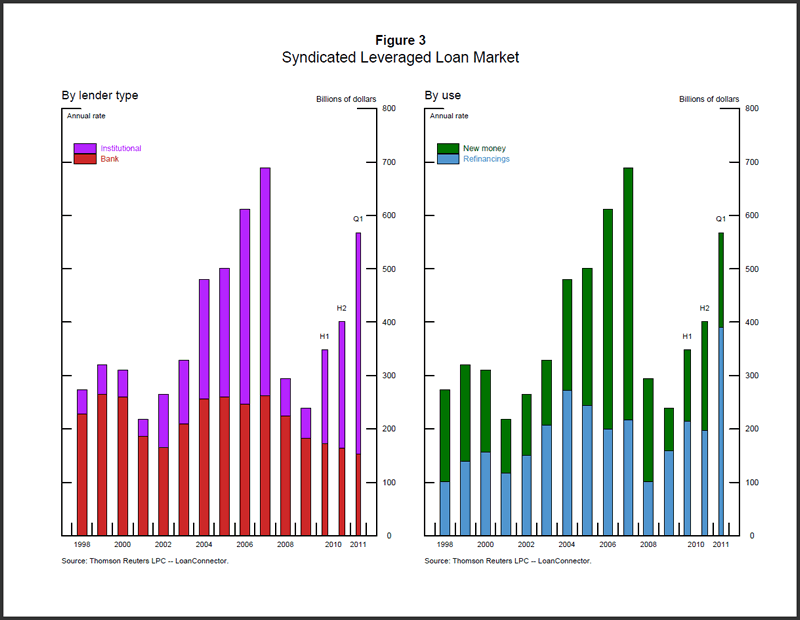
Syndicated leverage loan market 1998-2011 
 Indicates how financial markets coincide with economic conditions


The financial accelerator effect is the outcome financial circumstances relating to business and market outlays have in terms of specific economic conditions. More specifically, according to Ben Bernanke, Chairman of the Federal Reserve Board, the accelerator is itself a change to “financial and credit conditions” that affects the business operating environment. For example, if interest rates rise, the cost of capital also rises; if the business environment is experiencing a down-cycle, then the rising interest rates are thought to accelerate the negative impact of the business down-cycle which in turn influences economic conditions. 

A key function of the accelerator effect is to explain why certain financial conditions occur. When a cause for specific events can be proven to be the accelerator effect, then the reason for fiscal circumstances and actions can be illustrated and justified with more validity. For example, in a research study by an Bruno Coric Phd of the University of Spilt, it is claimed the accelerator effect itself serves as a model with which changes to business “outputs” are related to financial markets. In other words, the accelerator effect is a substantiated economic tool in the context of which economic scenarios are made clearer.

Even though there is some explanatory power to the accelerator effect, it is not completely illustrative of economically related financial scenarios. Moreover, as Ben Bernanke of the Federal Reserve and  Simon Hall of the Bank of England point out, the scenario described as the accelerator effect is not due to unique causes. Moreover, other variables also influence the economy which impact the accuracy of the accelerator effect as an explanatory tool. For example, even if financial obstacles such as access to financing are prevented from inhibiting business operation, there is still the question of how using available money would be profitably beneficial. 

Measurement of both economic and financial impact is also a key function of the accelerator effect. In a report by Amundi Asset Management the accelerator effect is measured by determining the quantitative changes to corporate investment behavior when economic stress is experienced in money supply, loans to firms, credit conditions and employment. To explain further, by gathering economic and corporate data, trend lines or 'financial affects' are measured. When these trends are statistically correlated to preceding and separate but similar economic scenarios, the impact of the accelerator affect can be numerically illustrated and corroborated.

Guidance is another function of the accelerator affect. The more an economic event can be demonstrated to be the accelerator effect, the greater the perceived utility of specific forms of monetary policy become. In other words, the affects of adjusting monetary policies to influence economic conditions are in part substantiated by the accelerator effect. In this context, if the cause of the financial accelerator is inhibited, the consequence in theory would be a reduction in the ability of that financial mechanism to amplify its economic impact leading to a change in the accelerator effect.

Tuesday, January 24, 2012

Corporate tribalism echoes a leadership style from ancient civilization

Image attribution: Kabuto 7; CC BY-SA 3.0

Corporate tribalism expresses the same nepotistic fear characteristic of political tribalism from times passed. Tribalism, with its chiefs, or in the case of corporations, chief executives, is an enclave of beliefs and practices governed by a paternalistic style hierarchy.

This type of management style was used in ancient Babylon, and many cultures thereafter as a way of coordinating society. It gave special rights, and even divine attribution to the leaders of those societies.

That was before people realized they could cooperate at an administrative level for the good of the whole without the tragedy of the commons setting in. Eventually, tribalism became suppressed in some cultures, and took a lower standing within society. It became demoted to the world of business leadership, at least in Western cultures that is.

Now, our businesses are run like tribes, and the same attributes of ancient tribes run rampant in corporations, for better or for worse. Fear of outsiders, hiring from within the tribe, competition with other tribes seeking the same thing, and use of similar resources in the same environment.

Saturday, June 18, 2011

How To Repair a Late S Corporation Election

An S-Corporation election repair is the option available to businesses within the United States to be considered an 'S-Corporation' for tax filing purposes by the U.S. Internal Revenue Service after the filing deadline has passed. Moreover, while S-Corporations can elect officers, the repair of late S-Corporation election refers to the late filing of a business as an S-Corporation i.e. after the April 15 fiscal year deadline mandated by the U.S. Internal Revenue Service. This article will illustrate what an S-Corporation is, benefits of electing to become an S-Corporation, how to repari a late S-corporation filing in addition to providing tips to consider when making the decision to reclassify a business as a S-Corporation.

What is an S Corporation?

S-Corporations have unique tax advantages that a sole proprietorship, partnership or limited liability corporation do not. Specifically, S corporations avoid owner self-employment tax and social security taxes on salary. However, the lower social security taxes can also imply lower social security recorded income and credits which can have an impact later in life. Additionally, since the corporation's income is not taxed, the shareholders are meaning tax is still paid, just not by the company but rather the shareholders unless there is a net loss which means shareholders can deduct the losses on their form 1040 income tax forms potentially lowering personal income tax significantly.

An S-Corporation is a small business registered with the U.S. Internal Revenue service. Generally, for a business to be considered an S-Corporation for tax purposes, the appropriate paper work must be filed with the IRS before April 15th of a given year to qualify as an S-Corporation for the previous year's tax filing and tax considerations. If this paperwork is not filed by April 15th, the company will not be considered an S-Corporation for the previous tax year unless a repair is completed.

How to "repair" a late S Corporation filing

To repair a late S-corporation election it is important to understand what qualifies a company for a late S-corporation election filing and how to go about registering the company after the April 15th deadline. To qualify for late S-Corporation election the business must file an IRS form 1120S (U.S. Income Tax Return for an S Corporation) and a form 2553 (Election by a small Business Corporation) with an explanation of filing late according to the IRS 2007 policy change. Additionally, an IRS form 8832 (Entity Classification Election) can be filed with the previously mentioned two forms. This joint filing of documents essentially slows down the bureaucracy involved in changing corporate status.

In addition to the above filing requirement, several other conditions must be met in order for the late S-Corporation election filing to be approved. The following link provides some useful tips on what to place on the late form 2553 in addition to timing, business structure qualification. To qualify as an S-Corporation a business can have no more than 100 shareholders or less as determined by the State of incorporation in addition to conformity with all the applicable State and Federal requirements of incorporation. These requirements can be obtained from the appropriate Secretary of State's office.

S corporation election tips

When filing to become an S-Corporation it can be wise to verify the businesses structure is appropriate for the shareholders and businesses needs and goals. Since corporate structure is generally a long standing decision that cannot be easily reversed, the implications of ineffectively incorporating or electing S-Corporation has the potential to be quite negative for businesses unaware of specific caveats, taxation, and liability implications. Becoming aware of these things can be assisted through the following tips.

• Implement a diligent company risk management policy
• Contact the Internal Revenue Service
• Contact a business consultant
• Verify registration requirements
• Assess potential advantages and disadvantages
• Obtain and accurately complete the necessary paperwork and information needed for the 

S-Corporation election

The above tips can potentially better inform business owners and officers of the necessary steps, requirements and affects of initiating a formal change in business status from another type of business. Also, to avoid complications in the filing process, reviewing the late filing paperwork can be beneficial especially if the businesses profitability and success depends on the transition to an S-Corporation.

Summary

An S-Corporation is a type of business classification within the United States of America. Business can elect to change their classification to S-Corporation provided they meet specific State and Federal filing requirements. In some cases, election to become S-Corporations may be filed with the IRS after the April 15th tax deadline. In such cases, a late election as S-corporation procedure exists to help expedite the process and eliminate unnecessary complication in the transition to a S-Corporation.

When a business chooses to become an S-Corporation, it can be beneficial to properly assess the necessary requirements of such in accordance with the businesses strategic goals. Furthermore, when filing an election to become an S-Corporation after the IRS tax deadline, the need for accuracy and proper filing is given more weight of importance, as the process is already somewhat at fault. This article has provided sources, instructions and tips on how to increase the chance of successfully filing a late election to become an S-Corporation.

Sources:

1. http://www.irs.gov/newsroom/article/0,id=174675,00.html
2. http://taxes.about.com/od/scorporations/a/scorp_formation_2.htm
3. http://www.microsoft.com/smallbusiness/resources/startups/business-plans-entities/more-pros-than-cons-to-becoming-an-s-corporation.aspx#MoreprosthanconstobecominganScorporation
4. http://www.irs.gov/pub/irs-pdf/f1120s.pdf
5. http://www.irs.gov/pub/irs-pdf/f2553.pdf
6. http://www.irs.gov/pub/irs-pdf/f8832.pdf
7. http://www.irs.gov/businesses/small/article/0,id=98263,00.html

Friday, April 29, 2011

Ending a General Partnership

Business partnerships involve two or more persons who are owners and in many cases officers of a company. This type of business relationship usually requires significant joint responsibility and collaboration on behalf of the partners for the partnership to succeed. When a partnership is broken it is called dissolution of partnership and the reasons and method for obtaining such dissolution are several.

Dissolution of partnership

A dissolution of business partnership can be caused by conflicts or irreparable differences between one or more of the partners. Additionally, an unsuccessful partnership may influence a partner's decision to leave along with a host of other possible reasons such as health, other commitments, passing away, loss of interest, dispute etc.

Disputing dissolution

Dissolution of partnerships can be contested in a court that has jurisdiction over the geographic area in which the business is registered and/or operated. Generally a court ordered dissolution takes place when an out of court settlement can't be reached. In such cases the judge will review the the positions of the partner(s) seeking dissolution and make a judgment based on his or her hearing of the case and review of the appropriate law. Judges may order a dissolution through appeal to a number of legitimate causes such as infraction of business terms of agreement, mental incapacity, or failure of a partner to comply with financial obligations within the partnership.

Ending business partnerships out of court

Most partnership laws within the United States require certain actions to be taken before a partnership is considered ended. Since partnerships are not incredibly formal types of businesses, the amount of paperwork that needs to be filed can be minimal if the ending of the partnership, and its terms are agreed upon by the partners without lawsuit. The required actions are as follows:

1. Give proper public and governmental notice as required by law
2. Pay all creditors what they are owed
3. Return Capital investments as originally invested by the partners
4. Distribute remaining assets and profits evenly among partners

The above steps may be more difficult than they sound especially if one partner goes bankrupt and leaves the remaining partner(s) with all the debt. For example, even though all partners are equally liable for debt in a partnership, a partner with no assets can't pay what isn't there after a bankruptcy
Tips to consider before ending a partnership:

• Partnership agreements:

Contractual partnership agreements are legally binding contractual documents that can be drawn up and signed during the formation of a partnership. However, it is not necessarily the case that such agreements can only be made at the beginning of a partnership and may help in the process of defining how assets in a partnership will be dissolved.

• Financial documents

Obtaining copies of all the partnerships financial documents at the time of dissolution is essential for determining each partners share of liability if any and also for supporting cases in which partners do not hold themselves accountable for their share of the partnerships debt.

• Avoid going to court

Going to court can be expensive, especially if all the partners decide they need attorneys to represent their interests. Amicable dissolutions are always more cost effective and the partnership laws generally put precedence on the interest of the partnership above the partners anyway.

• Refer to partnership laws

Understanding and referring to laws governing partnerships can be a good measure when one or more members ends their partnership. This is so for purposes of know how and legality. More specifically, the Business Partnership Act of 1958 and the relevant State law in which the partnership operates. The Unified Partnership Act is a more recent federal law that has been adopted by States in the regulation of partnerships.

• Know when to consult a small business attorney

There is a small difference from employing attorneys in the dissolution of a partnership and consulting a small business attorney for issue pertaining to the continuation of a partnership. For one thing it can more cost affective to receive attorney advice than have an attorney manage a case. Secondly, for partnerships that continue to exist after one or more partners leave the business there are on going legal concerns apart from the dissolution.

Ending a business partnership can be easy to do if the partners are agreeable, knowledgeable and capable of doing so. Since the legal formalities of partnerships are somewhat casual and/or limited, the dissolving of a partnership has the potential to be a straightforward process. The dissolution process can be complicated by financial issues such as excess liability, and failure of one or more partners to agree to the dissolution and terms of dissolution. Consulting the IRS Closing a Business Checklist may also a good idea, however the information, steps and tips in this article are provided as a supplemental resource only, and do not replace the terms of agreement between business partners or the laws governing partnerships.

Sources:

1. http://tinyurl.com/ctz8j (IRS)
2. http://findarticles.com/p/articles/mi_m1272/is_2676_130/ai_78256887
3. http://tinyurl.com/3wm3eog (Entrepreneur.com)

Wednesday, April 27, 2011

How to create a sales forecast

There are many ways to create a sales forecast, and how a sales forecast is made is not the same as what a sales forecast is. Some sales forecasts are more accurate than others, but the information used in making the sales forecast also contributes to its validity and largely pertains to existing and pre-existing selling activities. Sales forecasts can be made by hand on paper with a calculator, using Microsoft Excel, or with a specialized sales forecast software. Essentially one or more of the following are needed to make a sales forecast:

1. Past sales numbers
2. Sales and marketing budget numbers
3. Intervals at which the numbers are attributable to
4. Other dependent variables ex. Changes in sales force
5. Calculator, or Forecasting software

Determining which sales forecast to use for your business depends on 1) market consistency, 2) historical sales, 3) changes to marketing, project management or product and service line, 4) economic conditions and 5) forecast objective. This article will illustrate how to make different sales forecasts with different tools and methods, and then discuss the importance, relevance, pros and cons of sales forecasts.


Simple sales forecast using moving average

The moving average is a trend line that calculates an average number based on historical data. For example, if sales for the last two years averaged $120K per month and rose an average of 3% per month, a sales forecast that uses both moving average and the percentage rise in the moving average will give a sales prediction based on past sales patterns.

1. List historical sales on a piece of paper or spread sheet
2. Calculate moving average
3. Determine periodic percentage increase in sales
4. Create trend line by applying percentage increase to moving average

Sales forecasts using Microsoft Excel

A few types of sales forecasts can be made using Microsoft Excel. These different forecasts use data differently or adjust data to arrive at more accurate predictions. All forecasts are predictions unless the variables are 100% constant into the future. The sales forecasts below use moving average, dependent variable i.e. causal relationships, and independent variables i.e. sales values. (Microsoft.com)

1. Create three or more columns in a Microsoft Excel Spreadsheet
2. One column for sales and another for time period
3. Click on the chart wizard
4. Highlight data box, proceed through wizard steps
5. Click on Chart tab and add trend line

For more detailed analysis of the above sales forecasting method using Microsoft Excel, regression analysis can be used to calculate accuracy of the sales forecast, and correlations. The following Microsoft website illustrates how to do this and create a forecast in excel with more detail.

Sales forecast using statistical or specialized software

Software that is designed just for creating sales forecasts can provide easier to you applications that save precious time and energy. Additionally, specialized sales forecasting software may offer a variety of forecasting options such as multiple dependent variables, easier data input templates, more dynamic presentation, and greater analytical capacity. Sales forecasting software can be found for free online via sites such as http://www.freedownloadscenter.com

Advantages and disadvantages of sales forecasts

Sales forecasts are useful tools in business management because they help refine the business process and improve the accuracy of business financial planning. Sales forecasts can also be helpful in training teams, illustrating sales performance and planning future sales efforts. Additionally, sales forecasts may assist a business obtain financing for new projects or demonstrate the need for sales related changes.
• Reduce excess inventory and storage costs
• Allow management to gauge effectiveness of sales force
• Improve strategic planning and product testing 
• Assist sales force assess their efforts and market
• Creates records for budget considerations and analysis

Sales forecasts are only as good as the variables and factors put into the equation, software or calculation. Some forecasts may be mere estimates or ball park figures of what sales might be like given non measured past patterns. Other forecasts may fail to take into account significant changes in sales staff, budgets or product line(s). Thus, knowing the business in detail can help improve the accuracy of a sales forecast.

• May not account for changes in economic conditions
• Requires business conditions to remain constant
• Does not necessarily incorporate future projects
• Numbers affected from

In summary, sales forecasts are made relatively easily but do require a record of past sales and business variables to more accurately create a forecast using a moving average trend line. Sales forecasts can compare multiple variables on a graph, in addition to being displayed on data tables. The forecast accuracy can be measured with statistical analysis and multiple methods of creating sales forecasts exist including by hand, Microsoft Excel or specialized sales forecasting software downloads. Sales forecasts are generally not 100% accurate but do assist a sales team, business management and business ownership plan for and project future business situations and revenue which helps in inventory control, assessing human resources, budget and strategic decisions.

Monday, April 11, 2011

Different Types of Sustainable Business

The different types of sustainable business protect resources while simultaneously meeting the goals and objectives of business interests. According to the International Institution for Sustainable Development (IISA), different types of sustainable businesses require business strategies that define, implement, change, design and enhance aspects of business that affect sustainability.

Attributes of sustainable businesses include profitability and compliance with both environmental regulations and credible scientific knowledge regarding the impact of business practice on the environment. The IISA also states protecting, sustaining and enhancing human resources while not degrading those resources is a characteristic of business sustainability. This is interpreted to mean, keeping the work force alive and healthy, but not too wealthy to ensure ongoing or sustainable labor.

• Agriculture

Agricultural businesses necessitate sustainability as without it, crops simply fail. Without renewable resources such as the sun, rain and fertilizer agriculture would not exist. Since these types of businesses rely so heavily on sustainable resources it follows that proper management of those resources helps ensure sustainability of the business. Organic farmers nationwide have embraced sustainable business models that are health for the environment and people. What's more, according to a report from Inc. com's, businesses such as Frog's Leap Winery, the upfront cost of becoming a sustainable business are indeed profitable.

• Green energy

The green energy movement has been gaining momentum for some time now. Green energy businesses are in the business of sustainability. Businesses that create, build and install equipment that harness, store and distribute renewable energy are as sustainable as the resources that fuel these types of businesses are. Green energy businesses that utilize renewable parts and equipment that are environmentally safe naturally follow suit with the green energy sustainability they help promote.

• Waste management

Recycling, reuse, and re-integration are methods used by green waste management companies such as Waste Management Inc. This is one of largest waste management companies in the United States and has begun reusing the garbage it collects to fuel its trucks in addition to running and enhancing its traditionally earth friendly recycling programs. This type of sustainable business demonstrates how costs can actually be reduced by going green.

• Construction materials

Companies that recognize environmental and financial pitfalls of harvesting and wasting construction materials are green friendly and thus sustainable at some level. According to Inc. Magazine, a business called Hycrete has found a way to waterproof concrete with earth friendly chemicals that make it more efficient to reuse old concrete than costly to recondition. Green friendly businesses such as lumber supply companies that rotate crops to ensure a constant supply of wood without having to acquire additional land have also grasped the concept of sustainable business.

• Automotive

Auto manufacturers are on the sustainable business wagon as well. Increasingly energy efficient vehicle models are being designed, tested and marketed in an effort to meet earth friendly standards that test business models sustainability. Renewable energy news reports design concepts that support automotive business sustainability include fold up cars, self-repairing cars,  plastic cars and even plastic roads.

Different types of sustainable businesses span multiple industries among which there may also be unsustainable businesses. However, some industries are more apt to sustainability than others. To identify what the different types of sustainable business are it is helpful to understand what makes a business sustainable, and then match those attributes of sustainability with businesses and business models that have them. Business.gov provides an outline of qualities that business on the road to sustainability or that are already sustainable possess. These factors can be referred to as a qualitative measure of business sustainability.

Sources:

1. http://bit.ly/hobX28 (IISD)
2. http://bit.ly/3OaCy2 (Inc. Magazine)
3. http://bit.ly/8muj1    (Business.gov)
4. http://bit.ly/U0Xd8  (Green Energy News)

Saturday, April 2, 2011

Types of Tax Breaks For Small Businesses

Tax breaks reduce taxes owed to a government by an entity such as a small business. Different types of tax breaks for small businesses in the U.S. come in the form of tax deductions and tax credits and include a wide range of expenses and expenditures incurred by a business. The reason why the various types of tax breaks for small businesses are so useful is because they 1) reduce or eliminate taxation of business operating expenses and 2) can help preserve business retained revenue. The remainder of this article will outline business tax breaks and the process by which they are sometimes claimed.

Deductible business expenses

Amount the types of tax breaks available to sole proprietorships, LLC’s and partnerships are business expenses. These expenses take the form of deductions to taxable income which means a smaller amount of income will be taxed at a given tax rate after the deduction is granted. An example of a deduction available to sole proprietorships, S-corporations and partnerships are expenses for 1) licenses and 2) interest.

Tax deductible business expenses are costs incurred in the operating of the business, and are subject to specific tax regulations that should be complied with  before claiming the deduction. Even though some business operating costs are deductible doesn’t necessarily mean they are worthwhile expenses because the tax benefit is only a fraction of the actual cost. For example, if a business purchases a new antique diamond studded office fish tank for $10,000 thinking the cost can be written of through taxes, they may be in for a surprise. That office expense may not only be non-deductible; and if it is deductible may only reduce cost by the 15%-35% tax rate, or $1,500-$3,000 which that business is taxed.

Business tax credits

Being aware of the available types of tax credits is a good step in both tax planning and strategy in addition to tax filing. Not claiming tax credits can be costly to a business making the time and research used in becoming cognizant of  business tax credits potentially worthwhile. As with business expenses, identifying which IRS forms and publications apply to a specific business is helpful in identifying the most clear business tax credits qualified for. A few places to start looking for business tax credits are listed below:

(1) IRS Business Tax Credit information page
(2) U.S. Code on Tax Credits
(3) Tax strategy review
(4) Offshore business tax strategy
(5) State Departments of Revenue

Types of tax credits for small businesses may also be added or eliminated with changes to legislation in each new tax year. Generally, these changes to the tax law are updated by the IRS through edits on the relevant tax forms. However, it can be helpful to be familiar and up to date with available tax credits in case they are not clearly marked on the standard business tax return forms. Additionally, even though a space may be present on the Form, the information about the tax credit may be in a different IRS publication. For example, on the 2009 Form 1120-S is a line for other credits on line 13g. This line refers the tax filer to the instructions for form 1120-S. Thus, taking the time to read and be aware of multiple source on business tax credits may be beneficial to business retained income.

How to claim business tax breaks


Business tax breaks vary between the business types; for example, sole proprietorships are not necessarily subject to the same tax benefits as a partnership or limited liability corporation (LLC). So accordingly, an important step is determining the type of business for which the tax breaks are for. Each business type has different tax forms issued by the U.S. Internal Revenue Service (IRS). For example, an S-Corporation or small business is required to complete a Form 1120-S.

Step 1: Identify business type
Step 2: Locate correct tax forms
Step 3: Assess and research tax breaks 
Step 4: Apply tax break(s) to business tax return

The business tax forms that may be required include (1) Form 1040 Schedule C for sole proprietorships, (2) Form 1120-S for S-Corporations, (3) Form 1065 for business partnerships, and (4) Either a Form 1065, Form 1120, or Form 1040 Schedule C, depending on the type of LLC. For example, a limited liability corporation may have only one person who owns the business and who fulfills all the executive roles which may require the 1040 Schedule C be filed rather than a Form1120-S. The following link provides a more complete list and illustration of LLC tax filing classification.

Source: http://www.irs.gov (U.S. Internal Revenue Service)

How Businesses Show Customers They Care

Customers are an important part of any business; this makes ways to increase customer lifetime value necessary for sustainable profits within a static market. In fact, customers are so relevant to business that Customer Lifetime Value (CLV) is studied repeatedly in business programs and publications such as the Harvard Business School Publishing Corporation.

Source: U.S. Navy; PD-USGov

Even in a growing market it is a good idea not to forget the value of customers and what they mean to bottom lines. Showing customers you care is one way to help build a customer's perceived value of a business that contributes to a business's intangible value. In some cases, CLV is even measurable as demonstrated by the Harvard Customer Lifetime Value calculator.(1)

• Loyalty benefit programs

Loyalty benefit programs show customers you care by demonstrating recognition of their role as repeat clients. This helps build the B2P or Business to People relationship. Without loyalty benefit programs the chance of losing business to competitors increases.

• Personalized service

Impersonal communication with clients either means a company is too large for personal relationships or doesn't care about its customers. Large companies don't always maintain personal relationships because they believe utilizing human and financial resources in this way becomes statistically non-optimal.

• Improved customer service

Customer service creates impressions that last with consumers. Even if a company's management is impeccably ethical, this does not mean its employees are. Quality control of customer service helps ensure clients are receiving the service they pay for.

• Dispute resolution procedure

Few companies are likely to not experience disagreements or even litigation with clients. Reducing both these things can be assisted with a customer dispute resolution procedure. This type of process, if effectively designed and implemented, shows customers you care and may avoid costly legal proceedings or lost business.

• Referral incentives

Referral incentives are cheap to implement and therefore accomplish two objectives. First, effective referral incentives reduce the need for a costly marketing and sales campaign and secondly, it shows customers you care by offering incentives for a service those customers may have provided free of charge anyway.

Every business is different as are their customers. Showing customers you care involves understanding your customers' needs and that you value their business on a continual basis. Depending on the business environment, products or services, and customer beliefs, some methods may be more effective in showing customers you care than others.

Additionally, not all attempts at showing customers you care may be profitable individually or in aggregate. This makes an accurate assessment of company resource uses managerial and employee resources weighty part of business management.

Sources:

1. http://bit.ly/4QjPrf (Harvard)

Managerial Skills: Acting as a Role Model to Employees

A managerial role model is one who performs a role in a way admired, expected or respected in some way by a company and colleagues, be they executives, peers or employees. If role modeling is considered a priority in a business then it is important to 1) know your corporate culture, 2) become the embodiment of the most valued ideals in that culture, and 3) perform effectively within that role. Such role modeling may come with well defined communication, performance, and organizational behavior. The importance and relevance of managerial role modeling varies from business to business. Managerial role modeling is influenced by a number of factors.

• Management level influences role

The level of management is a factor as a lower level manager is closer in function and role to employees than an upper level manager. In such cases the distance between employee and manger often increases. This distance is partly due to differences in function but also interest. In such case two out of three or more premises for ongoing rapport between manager and employee are checked off the list of role relations.

• Priority of role modeling to the manager

The previous factor is not intended to state the task of managers is to be role models; to the contrary, role modeling is perhaps one of the less useful traits a manager can have because winning the respect of employees and colleagues is not a time effective pursuit, and the corporate structure is generally not currently designed to include role modeling as a significant aspect of business management.

• Variances in role modeling

Since roles differ from business to business so to does the role model. A role model in company A may be considered a jester in company B. In other words, the corporate culture will determine what the ideal role model is in terms of consensus. For example, an investment bank may have corporate values far different from a client or from an administration that practices Corporate Social Responsibility (CSR).

• Changes in role modeling over time

In terms of managerial skills, if a manager has to act, they may be in the wrong business unless they enjoy not being themselves. Roles also change with time, what was considered good form for a manager 50 or 60 years ago, would likely be considered non-ideal for a manager in many businesses today. Technology, management style, and managerial functions have all changed to an extent that a manager using half century old techniques may not last long especially if his or her colleagues are from another generation. Despite this, some values are often considered essentials regardless of time.

• Role modeling as corporate function

Managers should hope to have sufficient workplace cohesion if the company's functionality depend on it. If this requires role modeling, then the manager should consider the role important. Doing this means understanding employees and the business, and reflecting the expected roles in so far as is practical, feasible and efficient. Understanding basic needs of employees is often an essential ingredient in retaining and maintaining a working relationship within the corporate framework.

• Role modeling characteristics

In terms of traditional values, things like respect, manners, friendliness, work ethic, and good grooming may be desirable from a role model, but these values are somewhat outdated despite any authenticity of character they may hold. The essentials of business include pleasing shareholders, making a profit, and keeping a company out of trouble financially, organizationally and legally. This nexus of goals and relationships requires a manager to set priorities for him or herself. In some cases, being a role model may not be one of those priorities.

• Necessity for role modeling

The necessity for role modeling may be high or low depending on its relevance to the managerial function. In large part, employees also define what a role model should be by what they are willing or not willing to accept. Due to corporate structuring, this is often easily ameliorated by corporate authority, and not necessarily amicably. If a corporation values a particular kind of corporate culture and the company's performance depends on those values being implanted, the necessity for managerial role modeling may be higher.

Thursday, March 31, 2011

Different kinds of bank loans for small U.S. businesses

Small Businesses may obtain financing for various aspects of business operations through specialized bank loan products. This article will illustrate the various types of loans available to business owners through banks in addition to indicating how such loans can be approved. A discussion of a few banks and their loan products will also be provided for the purpose of further illustrating the types of loans available.

Types of bank loan products

• Lines of credit

A line of credit may be either a secured or unsecured account i.e. collateralized loan or uncollateralized loan. Lines of credit are similar to credit cards but usually have interest rates based on the prime rate and are thus lower. Lines of credit are more flexible than credit cards because they also act like accounts and checks can be written against them.

• Cash flow loans

Cash flow loans are used to finance periods of time within the cash conversion cycle. In other words, the time between providing a service, invoicing, and receiving the payment and then paying creditors. The shorter the cash conversion cycle is the more money a business can save in cash flow expenses such as interest on the cash flow loan or other source of credit. Companies that operate on a cash basis may not have the same requirements for cash flow as a business using the accrual method of accounting.

• Business credit card

Business Credit Cards have higher interest rates but can be used for solid bookkeeping. The reason credit card loans are good for bookkeeping is all the transactions are recorded electronically, immediately or soon after the expense has been charged. This can lower accounting expenses as some of the financial reporting is included as a service of the loan.

• Debt refinancing loan

Banks also offer debt refinancing loans that can consolidate other business debt at a lower interest rate. For example, if company A has 3 credit cards with other banks at an average interest rate of 14%, Bank B may be able to provide a loan refinancing all 3 credit card's debt at a lower interest rate. This allows the bank to acquire new business and the business owner to obtain a lower monthly payment.

• Equipment and machinery loans

Equipment and machinery loans can include vehicles, tractors, conveyor belts, irrigation systems etc. Many types of businesses have unique equipment and/or machinery needs for which these loans are designed for.

• Start up loans/seed capital

Seed capital is a loan used to financing the opening and initial operation of a business. In this case, small business seed loans are applied for and either approved or rejected by the bank. These types of loans can have rigorous application requirements that can be subject to significant scrutiny by the bank. Depending on the type of bank and their specialization, seed capital loans may be easier or 
harder to find.

How to qualify for bank loan products

Qualifying for bank loans depends on several factors including the interest rate of the loan, the type of loan product and the financial and professional credentials of the applicant. The more secure i.e. collateralized, high interest rate loans to clients with good to excellent credit histories and strong business fundamentals are the bank's ideal loan and customer because this provides a low risk of default and high rate of return.

Banks can't always have it there way however, and sometimes competition for loan products can cause interest rates to drop and loan application incentives to be introduced. For example, free services through the bank if a loan is approved. Depending on the type of loan the following criteria may be used when considering a loan application. Naturally, the better an applicant meets the criteria, the more likely the loan will be approved.

•Business Credit Rating
• Balance Sheet Information 
• Financial Ratios ex. Current ratio, profit margin on sales, debt to assets ratio.
• Professionalism and Quality of Application
• Collateralization
• Banking relationship

Banks and bank loan products
There are many banks to choose from with varying loan products. Some banks have specialized loans such as vehicle loans while others may have more general loans. Larger banks have more capital to lend and so obtaining a loan may be easier through a large bank if the loan is for a large amount. A few of the larger U.S. banks that either specialize or write a significant amount of business loans are listed below.

1. Bank Of America: This large U.S. bank has a wide array of business loan products.
2. CIT Coporation: A business friendly bank specializing in business loans.
3. CitiGroup: Another of the larger U.S. banks with large asset resources and loan products

Local banks may not be able to provide the same liquidity and financing as larger banks but they may have better customer service and loan products that suit one's business better. For example a local rural bank may have loans specifically for farming equipment and machinery. Depending on the type of loan, different smaller banks may specialize in or more types.

Small business loans are in plentiful supply within the United States. The variety and terms of U.S. business loans can be quite diverse and the application requirements depend on the type of loan in addition to other factors such as risk to the bank, rate of return etc. When researching a small business loan, the information contained in this article may be useful as reference and/or starting point for obtaining the right loan for a small business.

Thursday, March 24, 2011

How to Assess if Your Business Insurance Provides Adequate Coverage

A good approach to take when assessing if your business insurance provides adequate coverage is to go through a series of steps that address business hazards, assess replacement costs, identify insurance risk probabilities, and evaluate insurance options. The following five steps, one at a time. These steps can assist business owners or managers in determining if their business insurance coverage is adequate.

Business insurance factors

The following topic points can help a business manager or owner 1) itemize which business insurance coverage you need most, 2) accurately assess the value of your business or separate items within the business, 3) classify insurance coverage according to risk, cost and probability and 4) help in knowing what to look for if and when you decide what coverage is best for your business.

Business insurance is a business decision and should therefore be approached in a business like manner. Assessing if your business has the right amount of coverage can be done in a way similar to determining how much to spend on advertising, how much inventory to hold, and how to best implement a revenue strategy. In other words, insurance is no exception to the business of business.

• Address business hazard(s):

Addressing business hazards can be accomplished by by a) studying your articles of corporations, bylaws and any contracts if applicable, b) familiarize with the state and federal law which your business is subject to, and c) perform a business analysis of your operational hazards, possible liabilities, and asset structure. Doing these things will assist you in your first line of defense against financial loss.

• Assess replacement costs

Use up to date balance sheets and net worth estimates when determining the replacement cost of your business. If you forecast asset and net worth growth accounting for this in your business insurance coverage may be a good idea. Properly documenting inventory, equipment, building and other assets is important in proving the worth of your business to an insurer if you need to file a claim. It might also be a good idea to keep in mind insurance companies distinguish between replacement costs and actual worth in their policies.

• Identify risk probabilities

Prioritize risk probabilities with insurance coverage. For example, if your business risk assessment indicates you are less at risk of loss from theft, and the theft aspects of the insurance cause it to be a high percentage of the premium, placing this type of coverage lower down in your coverage assessment may be a wise choice. Conversely, if your business risk assessment deems your liability risk to be high and this insurance coverage is less expensive, you may decide this item should go to the top of the coverage requirements.

• Evaluate insurance options

Become acquainted with the types of insurance and insurance packages available. Essentially there is insurance coverage for almost everything, not including bankruptcy. However, declines in revenue directly attributable to 'interruptions' in the typical daily process of your business can be insured. From employees to buildings, there's often business insurance coverage available. If you are not already aware of the types of coverage available, it shouldn't take you long to find out as there are man insurers who would be more than happy to get your attention and money to serve your business needs.

If these previous steps are carried out effectively, you should have a good idea of what your greatest insurance needs are. With this knowledge you can then speak with insurers about coverage deals. Shop around for the most competitive bid or quote. By tweaking, adjusting deductibles, coverage amounts, and business protections the quotes may go down. Also, by combining policies and streamlining your business for efficiency, you not need as much as equipment and inventory that can lower insurance and operational costs.

Additional business insurance considerations

• Business structure 

Limited Liability Corporations (LLC's), Sole Proprietorships, S-Corporations, C-Corporations, and Partnerships all have differences that can affect whether or not the business is adequately covered by insurance. Knowing the legal aspects of your business structure and the operating vulnerabilities of your business can help you a) save unnecessary costs, b) protect you and/or your business from law suits, c) and potentially increase clientele through brand confidence.

• Business specific insurance needs

There may also be business specific insurance needs that aren't covered by the usual business insurance policy. For example, athlete injury insurance, essential body part insurance, website insurance, indispensable employee insurance, or officer kidnapping insurance. Periodically reassessing your business insurance needs may also be a good idea if the business structure, features, assets, employees etc. change.

• Developments in insurance products

Business insurance coverage itself may change over time as well making the need for business insurance reassessment a part of managerial operational adjustments. When you have determined your business insurance needs, doing a once over of our assessment with one or more of your insurer, business executives, partners, or employees may help uncover business insurance shortcomings, overestimates and insurance coverage optimization techniques.