Pages

Labels

Showing posts with label business operations. Show all posts

Monday, August 13, 2012

How the accelerator effect works

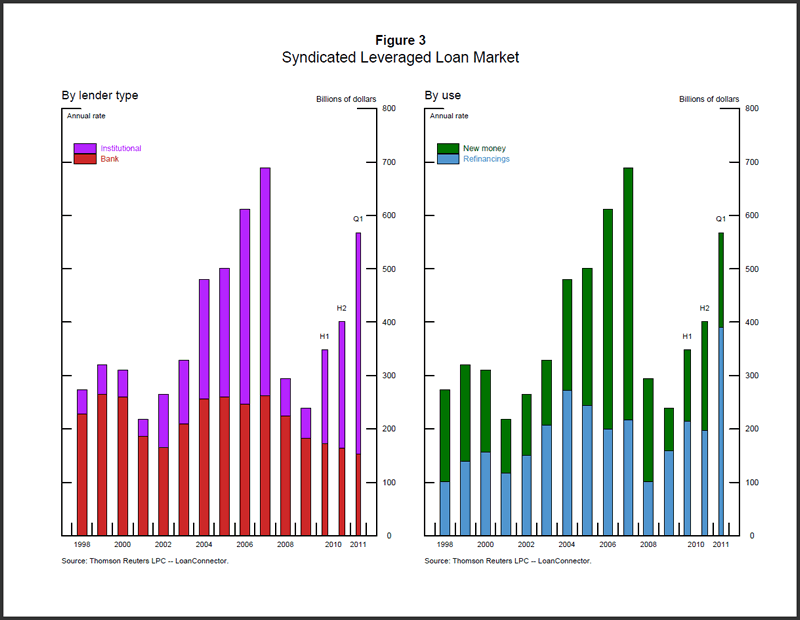
Syndicated leverage loan market 1998-2011 
 Indicates how financial markets coincide with economic conditions


The financial accelerator effect is the outcome financial circumstances relating to business and market outlays have in terms of specific economic conditions. More specifically, according to Ben Bernanke, Chairman of the Federal Reserve Board, the accelerator is itself a change to “financial and credit conditions” that affects the business operating environment. For example, if interest rates rise, the cost of capital also rises; if the business environment is experiencing a down-cycle, then the rising interest rates are thought to accelerate the negative impact of the business down-cycle which in turn influences economic conditions. 

A key function of the accelerator effect is to explain why certain financial conditions occur. When a cause for specific events can be proven to be the accelerator effect, then the reason for fiscal circumstances and actions can be illustrated and justified with more validity. For example, in a research study by an Bruno Coric Phd of the University of Spilt, it is claimed the accelerator effect itself serves as a model with which changes to business “outputs” are related to financial markets. In other words, the accelerator effect is a substantiated economic tool in the context of which economic scenarios are made clearer.

Even though there is some explanatory power to the accelerator effect, it is not completely illustrative of economically related financial scenarios. Moreover, as Ben Bernanke of the Federal Reserve and  Simon Hall of the Bank of England point out, the scenario described as the accelerator effect is not due to unique causes. Moreover, other variables also influence the economy which impact the accuracy of the accelerator effect as an explanatory tool. For example, even if financial obstacles such as access to financing are prevented from inhibiting business operation, there is still the question of how using available money would be profitably beneficial. 

Measurement of both economic and financial impact is also a key function of the accelerator effect. In a report by Amundi Asset Management the accelerator effect is measured by determining the quantitative changes to corporate investment behavior when economic stress is experienced in money supply, loans to firms, credit conditions and employment. To explain further, by gathering economic and corporate data, trend lines or 'financial affects' are measured. When these trends are statistically correlated to preceding and separate but similar economic scenarios, the impact of the accelerator affect can be numerically illustrated and corroborated.

Guidance is another function of the accelerator affect. The more an economic event can be demonstrated to be the accelerator effect, the greater the perceived utility of specific forms of monetary policy become. In other words, the affects of adjusting monetary policies to influence economic conditions are in part substantiated by the accelerator effect. In this context, if the cause of the financial accelerator is inhibited, the consequence in theory would be a reduction in the ability of that financial mechanism to amplify its economic impact leading to a change in the accelerator effect.

Sunday, September 18, 2011

How businesses write up work-orders

Knowing how to write up a work order can improve a business' work-flow process, if not help save a business operation from inefficiency. Work orders and work order systems vary between businesses but can be written up to meet business job or project needs effectively. For example, if a business has a lot of client field jobs, a mobile work order system with GPS, and integrated data transfer can speed up and improve worker efficiency.

Work orders are the medium with which business tasks are documented, implemented with and recorded. Some types of work orders might involve completing a form, recording it on a computer system then delivering it to the project manager or appropriate worker, while others might consist of a verbal order and a computer entry. The following steps can help with properly knowing how to create and implement a work order.

• Define

Defining what a work order is to do is key in writing or creating a work order. If the work order doesn't have the right information on it, or isn't compatible with the business operation it is used for, then it may be incomplete, or incomprehensible. To illustrate, if clients are often on the internet, a web based order mechanism can be automatically transferred and entered into the work order system by the client.

• Develop

Either create a work order template or locate a work order software. If work orders need to be duplicated, an affordable duplication method may be used. For example, electronic orders or audio dispatch. Work order software that can be integrated with existing business applications may be idea. For example, DeFNiC has a work order software that integrates with Quicken.

• Optimize

A well designed work order will  only have necessary information and not redundant data. Work orders should be quickly created, recorded, organized, adjusted and released in a cost effective way. If combining a work order with a job order, information such as job instructions and materials used can be added with the order number, date, account, job description, client, and costs.

• Review

After the work order process is complete put it to the test by reviewing how well it works on a limited basis. The work order system can be tested on one or two clients using one or two responsible employees for feedback and observation. Weed out any bugs or flaws in the system sooner rather than later and before making the work order system primary or live.

• Refine

As work is completed the work order should be accurately updated. A cloud computing work order software such as Service Max, or Adhere Solutions work order management may be the right tool this. If the software is also electronically linked to an accounts receivable account and other financial records, this may help reduce bookkeeping time and errors.

A work order mechanism can be as simple or as complicated as you want it to be. Some work order processes may be complex and detailed, even if stated to be simplified; an example being government purchase work orders. Each business is likely to have specific template requirements and bookkeeping systems. For this reason, making a work order adaptable within an accommodating work order mechanism is especially effective in dynamic and ever changing business operations.  

Sources:

1. http://bit.ly/cRcK32 (U.S. Government Printing Office)
2. http://bit.ly/9ivsjt (Miami Dade College-J.Hortens)
3. http://bit.ly/dvMPyU (DeFNic)
4. http://bit.ly/dlx3hl (Service Max)
5. http://bit.ly/cL1BD6 (Adhere Solutions)

Saturday, May 14, 2011

Business Office Technology of The Near Future

Offices have undergone drastic changes in the last several decades from typewriters to computers, carbon copy to photocopy, from low level lighting to commercial fluorescent lighting and from hot humid offices to air conditioned worked environments. Technological advancements in the working environment will continue so long as technology can be affordably integrated into the commercial environment. Such changes are likely to occur in all types of industry including the service and manufacturing industries.

Technology advancements in the service industry

The service industry spans a large range of commerce and has become more important in the United States than the manufacturing industry. With changes in technology, employee demographics and skills, cost management and other work related factors, the service industry has already and will likely continue to adapt. A few changes that may continue in the service as a means of both optimizing work force, productivity and cutting office costs include the following:

• Telecommuting software

Several service industries already make use of telecommuting software. An example being the outpatient nursing business in which nurses visit patients and upload care management information via the internet using company provided software on information processing equipment. This allows the nurses to be more productive and affords them greater flexibility through saving time commuting to an office when they could be meeting client needs instead. Similar software is used in other industries and the telecommuting trend may rise to incorporate work life balance, non-standard work hours, lower office space requirements and so on.

• Energy efficient computing

Another area where change is occurring is in the area of computing efficiency. Since computers, servers and information storage devices use a significant amount of energy, the creation of energy efficient computing devices is a natural stage in the evolution of information technology. This can not only save companies on energy costs, but also help the environment.

• High capacity processors

The trend of higher capacity computer processors has been active for several years and has recently continued to be developed and improved upon in various ways whether it be higher storage capacity, greater speed, lower energy usage or smaller space requirements. The evolution of computer processors makes possible greater tasks, functions and capacity thereby improving the potential for computers in the workplace.

• Interactive Voice Communications

Teleconferencing has existed for some time now but may also develop further through combining internet capabilities with enhanced voice transfer capacity. Cell phones, internet, computers and telecommunications infrastructure may advance such that the a larger and faster facility is enabled and in doing so improve interactive voice communications in the office.

Technology advancements in the manufacturing sector

The manufacturing sector includes production of large equipment such as vehicles, conveyor belts, building supplies, electronic equipment, energy production and refining etc. As with the service industry, manufacturing is also able to benefit from advances in technology. A few potential developments that may emerge to a greater extent in the manufacturing industry are the following:

• Electronic Engineering

With more sophisticated computer programming, functionality and reliability, engineering may incorporate a greater amount of computer technology into various industries. For example, automobiles have already begun to incorporate computerized components, mining companies use computerized equipment to test geographical areas before mining and architects and engineers may continue to use in increasing ways, modeling software to test designs, strength, building requirements and adjustments for the purpose of saving time and energy in physical modeling and cost in terms of correcting potential problems via computer before they start in reality.

• Artificial Intelligence

Artificial intelligence involves computer hardware and software that is able to learn and integrate new information on its own without additional input from a programmer or user. This can enable computers to do more and become more flexible within industry thereby allowing humans greater capacity to perform higher level decision making tasks.

Other office technological advancements

Additional technological changes may span both service, manufacturing and other industries if not create new industries altogether. Two more examples of how progress in the field of technology may influence the commercial environment and future offices are the following.

• E-Commerce focused Information Technology

The internet has led to an expanding ecommerce environment in which brick and mortar companies have been replaced with warehouse delivery operations. In other words, the sales and marketing has shifted toward the internet placing less demand and revenue generation in the hands of traditional companies that service walk in clients. Consequently, offices may focus more heavily on ecommerce information technology in the future, and less on office designs and space suited to walk in clients.

• Digital Security

Security guards and surveillance cameras traditionally maintained Security. While these two forms of security are not disposable and will likely continue to be utilized in the future, other mechanisms of security may be integrated into total office security systems. For example, DNA scans may more effectively verify the identity of a person than the possession of an ID card or badge encrypted with scanning codes that unlock doors, computer programs etc.

Summary

Office technology is an aspect of the information age that is difficult to ignore. To stay competitive, profitable and meet commercial demands, technology continues to evolve and be innovated and in some cases be affordable enough to work its way through commercial and civilian environments. This has happened in the past and if the trend continues, progress into the future changing the face of the office environment again and again for many years to come.

Sources:
1. http://www.cfo.com/article.cfm/5621073
2. http://tinyurl.com/3rs6459