Pages

Labels

Showing posts with label architecture. Show all posts

Tuesday, October 27, 2009

Historical importance, indeed

This one is for Christopher, whose memories of the cathedral in Cologne prompted me to tell my own anecdote about our visit there.

Darwin and I visited Cologne in the spring of 1999. Our train trip into Germany was an ordeal by non-reservation -- after tooling about laid-back Austria and Italy, no one had told us that the Germans would reserve every seat on the train. We squeezed in the corridor (along with everyone else who didn't reserve) and spent all night trying to melt into the wall to let a group of drunk Americans tromp back and forth to the lavatory. A memorable, if not comfortable, ride.

The press had lightened by the time we were approaching Cologne. Finally able to sit down in a compartment, we glued ourselves to the window, thrilled by the sight of the spires that suggested an end to our journey. But as the miles of fields stretched onward and the spires loomed ever larger and larger, our impatience to be there paled before the realization of the massive scale of the dom. The fact that we could see it meant not that we were close, but that it was mind-bogglingly, humblingly huge.

In the paved plaza before the cathedral, we strolled about amidst the other tourists, feeling dwarfish. And then, we saw it. At our feet was stone, almost indistinguishable from every other stone in the plaza, except that it was engraved. In English. We reached for the camera.


The photographic proof of this is now matted and framed in the kitchen. Every day we see it, in the triple frame between the statue of Anonymous from Budapest and the fountain from the same plaza. And almost every day we wonder: What does it mean? Who put it there? And why didn't he know whether or not it was a place of historical importance? Was he implying that one day it would be a place of historical importance? That at this moment it was a place of historical importance and he just didn't know it yet?

The one who laid the stone was a careful man, hedging his bets. He allows that historical importance might spring from, yea, this very moment, and yet he does not assume that the moment is already historical. He leaves a monument in case one day history will come back to vindicate his cautious assessment of its possible progress. And yet he leaves no name, so he will not be blamed if history proves to be a bitch and fails to provide that place with any import.

Here's some interesting history on the Cologne cathedral as well as a fascinating historical image.

The official cathedral website -- the English page, I think. There's a 3o minute documentary which one can watch in English with lots of great history and pictures.

Monday, September 28, 2009

Decline and Fall

This breaks my heart: The WSJ does a profile on a 90-year-old house in Detroit, in which the decline of the beautiful home and neighborhood mirrors the city's own descent.

The brick-and-stucco home at 1626 W. Boston Blvd. has watched almost a century of Detroit's ups and downs, through industrial brilliance and racial discord, economic decline and financial collapse. Its owners have played a part in it all. There was the engineer whose innovation elevated auto makers into kings; the teacher who watched fellow whites flee to the suburbs; the black plumber who broke the color barrier; the cop driven out by crime.

The last individual owner was a subprime borrower, who lost the house when investors foreclosed.

...But, battered and forlorn today, both Detroit and 1626 W. Boston Blvd. were solid and optimistic 90 years ago.

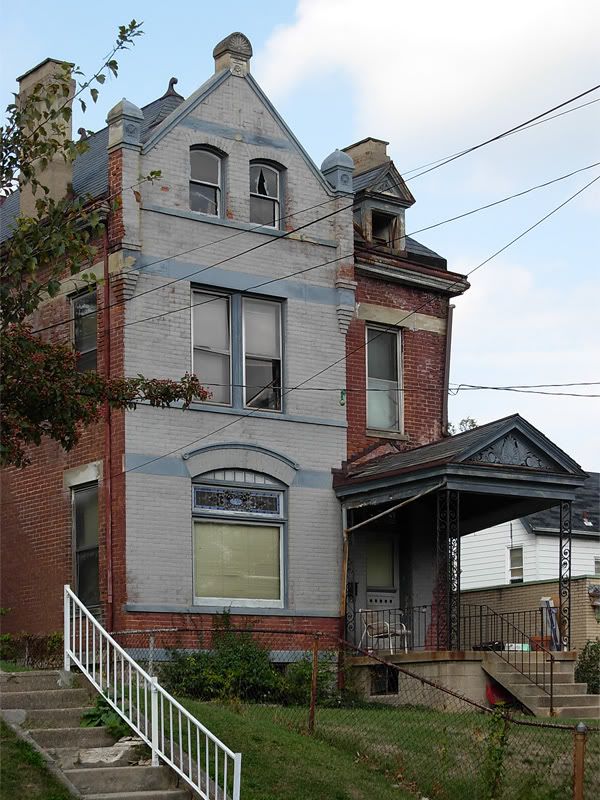
Taking a new route on vacation this spring, I passed through urban St. Louis for the first time. The gorgeous houses near the freeway took my breath away, but all too evident were the signs of urban decay. Who had built those homes, and what would they make of them now? The downward trend isn't unique to St. Louis or Detroit. I see this decline duplicated in areas of Cincinnati: neighborhoods that used to be proud and gracious have become battered and sullen.


Via the Building Cincinnati Photobucket site, which has numerous albums of Cincinnati photos.

Perhaps it's because until I was 12, my family lived in a succession of rather disposable trailers, but it tears me apart to see a fine old house in a state of neglect or active disrepair. True, for a good formative period, one of those trailers was on nine acres of land in rural Virginia, so the outdoor splendor more than compensated for disposable living quarters. Still, I remember when we were planning to move to Ohio, my siblings and I carefully wrote out a list of what we wanted in a house: wood floors, a fireplace, a secret passageway, a laundry chute -- marks of a home that was built quality, built to last. (As it turned out, we had all four in the house we first rented. There was a pathway in the attic that ran between the two upstairs bedrooms, and if you wanted to sit peacefully up there, you nestled against the brick chimney that jutted into the space. The fireplace had been turned into the kitchen pantry, but no matter; we knew it had once been there. We put the cat down the laundry chute, and there is no consensus of memory on whether we tried the same with the baby.)

It did not occur to me as a child that some people would not value a beautiful older house in a beautiful older neighborhood. Perhaps the term "Victorian" applied to architecture had a particular allure because it was so different from where I lived. The concept of upkeep or the desire to flee a crime-ridden neighborhood despite the original glory of the houses were completely alien ideas, as were "white flight", "urban decay", or "factory closing". But I did know that in 100 years our trailer would be rubble (as indeed will the suburban box I now inhabit), whereas even at their century, the gorgeous homes that were built for living and built to last still cast spells even through a heavy haze of neglect.

This past April, the Central Detroit Christian Community Development Corp., a nonprofit, bought Clarence Avery's house for $10,000.

One day this summer, Lisa Johanon, the group's executive director, undid the padlock on John Crawford's boarded-up front door. Sheets of peeling paint hung from Marie Ryan's kitchen ceiling. Advertising fliers littered the porch where Veronica Adams's neighbors played jacks. The glass was missing from the window on the staircase to David Andrews's third-floor sanctuary. Kimberly Carpenter's radiators had been stolen.

Usually, Ms. Johanon's charity provides subsidized housing in the poorest neighborhoods -- where ice-cream cones are sold from behind bullet-proof glass -- not high-end areas such as Boston-Edison. But now some 100 out of the 900-odd houses in Boston-Edison are vacant.

If you can't save 1626 W. Boston Blvd., Ms. Johanon wondered aloud, what hope is there for the rest of Detroit? Walking through, she noted the heavily stained carpet and the rickety back steps, but also the rich woodwork and the clawfoot tub.

She hopes her group can revive the house and find a new family willing to bet on Detroit. "A minimal spec, I'd say, would be $30,000 to $35,000, and it would be in pretty good shape," she said.

On a related note, my dad's nearly 100-year-old house is still for sale. Go ye forth and buy it.